 KSOEM
KSOEM

Articles
- Page Path
- HOME > Ann Occup Environ Med > Volume 38; 2026 > Article
- Original Article Association between workplace cooperation and depressive symptoms differs according to employment type: the 7th Korean Working Conditions Survey
-
Jung Wook Kim1
 , Youngdo Kim1, Jung Ho Yang2,3,*
 -
Annals of Occupational and Environmental Medicine 2026;38:e30.
DOI: https://doi.org/10.35371/aoem.2026.38.e30
Published online: July 14, 2026
1Department of Occupational and Environmental Medicine, Institute of Environmental and Occupational Medicine, Inje University Pusan Paik Hospital, Inje University College of Medicine, Busan, Korea
2Department of Preventive Medicine, Chonnam National University Medical School, Hwasun, Korea
3Gwangju Metropolitan City Environmental Health Center, Gwangju, Korea
- *Corresponding author: Jung Ho Yang Department of Preventive Medicine, Chonnam National University Medical School, 322 Seoyang-ro, Hwasun 58128, Korea E-mail: st15231@naver.com
• Received: March 20, 2026 • Revised: July 2, 2026 • Accepted: July 2, 2026
© 2026 Korean Society of Occupational & Environmental Medicine
This is an Open Access article distributed under the terms of the Creative Commons Attribution Non-Commercial License (https://creativecommons.org/licenses/by-nc/4.0/) which permits unrestricted non-commercial use, distribution, and reproduction in any medium, provided the original work is properly cited.
- 1,088 Views
- 37 Download


Abstract
-
Background The relationship between workplace cooperation and mental health has gained increasing attention. However, the extent to which employment type moderates the association between workplace cooperation and depressive symptoms remains underexplored. The present study aimed to investigate the association between workplace cooperation, depressive symptoms, and employment type among South Korean wage workers.
-
Methods The present work analyzed data from the 7th Korean Working Conditions Survey (KWCS), including 25,259 wage workers aged 20 years and older. Employment type was categorized as one of regular, temporary, or daily laborer. Workplace cooperation was assessed using a five-point Likert scale item regarding cooperation among colleagues. Depressive symptoms were measured using the World Health Organization (WHO)-5 Well-Being Index. Multivariable logistic and linear regression analyses were conducted to evaluate the association between workplace cooperation and depressive symptoms or the WHO-5 Well-Being Index.
-
Results Cooperation was significantly associated with lower odds of depressive symptoms in regular workers (odds ratio [OR]: 0.538; 95% confidence interval [CI]: 0.498–0.581), temporary workers (OR: 0.666; 95% CI: 0.561–0.790), and daily laborers (OR: 0.479; 95% CI: 0.339–0.679). The association between workplace cooperation and depressive symptoms differed significantly by employment type (interaction p = 0.016 for temporary vs. regular workers): the inverse association was weaker among temporary workers than among regular workers (interaction OR: 1.261; 95% CI: 1.045–1.522), whereas no significant difference was observed between regular workers and daily laborers (interaction OR: 0.912; 95% CI: 0.651–1.279; p = 0.595).
-
Conclusions Workplace cooperation was significantly associated with lower odds of depressive symptoms across all employment types, but the magnitude of this protection varies significantly by employment status.
BACKGROUND
Depressive symptoms are associated with impairments in daily functioning and occupational performance, diminishing quality of life and workplace productivity.1 Employees exhibiting high levels of depressive symptoms have increased absenteeism and reduced job retention, leading to substantial organizational losses.2 Accordingly, depressive symptoms are regarded as a major risk factor that threatens both individual health and organizational functioning and should be prioritized when designing workplace-based prevention and intervention strategies.
Previous research has consistently demonstrated that the psychosocial work environment, particularly supportive interpersonal relationships among coworkers, is closely associated with workers’ mental health outcomes.3 Workplace social support and collegial relationships characterized by trust, reciprocity, and mutual assistance have been associated with lower levels of depressive symptoms.4 Workplace cooperation may be conceptualized as a practical dimension of workplace social capital, reflecting the extent to which employees experience collaborative and supportive interactions with colleagues.5 Employees working in more cooperative environments may perceive greater social connectedness, which has been associated with better psychological well-being.6
On the other hand, the diversification of employment types and the increasing proportion of non-regular workers in the labor market are global phenomena that impact workers’ health and occupational experiences.7,8 In particular, the distinction between regular and non-regular employment encompasses the patterns of job security, career development opportunities, and organizational integration.9,10 Non-regular workers of temporary, part-time, or contract positions may have limited access to organizational resources and social support systems.11
These disparities in employment conditions may fundamentally alter how workplace cooperation is associated with mental health outcomes.12 To our knowledge, however, there is a lack of empirical studies investigating whether employment type moderates the association between cooperation and depression. Therefore, the present study aimed to analyze the association between workplace cooperation and depressive symptoms according to employment type, and to evaluate potential interaction effects using data from the 7th wave of the Korean Working Conditions Survey (KWCS).13
METHODS
This study analyzed data from the 7th wave of the KWCS. The KWCS is a nationally approved statistical survey administered by the Occupational Safety and Health Research Institute under the Ministry of Employment and Labor. The 7th wave of the KWCS was conducted in 2023 and included 50,195 employed participants aged 15 years or older across 17 provinces of South Korea. Among 50,195 participants, 20,967 were excluded because they were not wage workers, but self-employed or unpaid family workers. Additionally, 107 subjects aged less than 20 years were excluded. Finally, 3,862 participants with missing covariate values were excluded. Fig. 1 illustrates the protocol for selecting the final study sample, and Supplementary Table 1 presents the participants' characteristics according to study exclusion due to missing covariate data.
Type of employment
Employment type was categorized based on responses to the question “Which of the following is the type of employment under your contract?” Respondents were categorized as regular, temporary, or daily workers. Regular employment was defined as workers with no fixed term or with a contract period of at least 1 year. Temporary employment denoted workers with a contract period of more than one month but less than 1 year. Finally, daily employment included a contract period of less than 1 month or workers who were employed daily and received daily wages.
Cooperation
Workplace cooperation was assessed by responses to the question “There is good cooperation between you and your colleagues” on a five-point Likert scale. Responses of “strongly disagree,” “disagree,” and “neutral” were classified as poor cooperation, while “agree” and “strongly agree” were categorized as good cooperation.
Depressive symptoms
Depressive symptoms were assessed using the World Health Organization (WHO)-5 Well-Being Index. Although originally designed to measure mood and overall quality of life, the WHO-5 has shown strong validity as a screening tool for depressive symptoms and has been widely applied in diverse research settings.14,15 The total score ranges from 0 to 25, with scores of 13 or less indicating a high risk of depression, and scores greater than 13 classified as normal.
Covariates
Educational attainment was classified into “high school or below” and “college or over”. Marital status had two levels: “married” and “single.” Monthly income was divided into four groups of “below 2.0,” “2.0–3.0,” “3.0–4.0,” and “over 4.0” million Korean won (KRW). Occupation was classified as white-collar (managers, professionals, office workers), pink-collar (service and sales workers), or blue-collar (technicians, skilled agricultural and fishery workers, craft and related trade workers, plant and machine operators, elementary workers, and military personnel). Workplace size was categorized into 3 groups: less than 10, 10–249, and 250 or more. Worktime consistency was defined as having both daily worktime consistency and weekly workday consistency. Participants who reported consistency in both daily working hours and weekly working days were classified as having worktime consistency; all others were classified as not having worktime consistency. The weekly work hours were classified as “40 hours or under,” “41–52 hours,” and “over 52 hours.” For participants who reported monthly working hours, weekly working hours were calculated by dividing monthly working hours by 4. Job autonomy was assessed using three KWCS items asking whether workers could choose or change their order of tasks, methods of work, and speed or rate of work. Participants who reported autonomy in two or more of these three domains were classified as having job autonomy; otherwise, they were classified as not having job autonomy. Work demand was operationalized as work intensity using two KWCS items: working at high speed and working to tight deadlines. Each item was scored from 0 to 100 according to the proportion of working time exposed to the condition: 100 for all of the time, 90 for almost all of the time, 75 for three-fourths of the time, 50 for half of the time, 25 for one-fourth of the time, 10 for rarely, and 0 for never. The two scores were summed, and participants were classified as having low work demand if the total score was 0–35 and high work demand if the total score was 36–200. Customer interaction was assessed by the item “Dealing directly with people who are not employees at your workplace, such as customers, passengers, pupils, or patients” on a 7-point Likert scale (1 = “All of the time,” 2 = “Almost all of the time,” 3 = “Three-fourths of the time,” 4 = “Half of the time,” 5 = “One-fourth of the time,” 6 = “Rarely,” and 7 = “Never”). For analysis, responses from “Half of the time” to “All of the time” (categories 1–4) were coded as high customer interaction, whereas responses from “one-fourth of the time” to “never” (categories 5–7) were coded as low customer interaction.
Participants’ characteristics were summarized as mean ± standard deviation for continuous variables and number (proportion) for categorical variables according to employment type. Differences across employment types were assessed using one-way analysis of variance for continuous variables and chi-squared tests for categorical variables. The association between workplace cooperation and depressive symptoms was examined using multivariable logistic regression models in each employment type strata.
Logistic regression analyses were performed using three sequential adjustment schemes. Model 1 was adjusted for sex, age, educational attainment, marital status, and monthly income. Model 2 was further adjusted for occupation type, workplace size, worktime consistency, weekly working hours, and shift work. Model 3 additionally included job autonomy, work demand, and customer interaction.
To assess effect modification by employment type, a pooled logistic regression model including an interaction term between workplace cooperation and employment type was fitted using the full adjustment. The interaction was evaluated using a Wald test, and the coefficient of the interaction term, corresponding ratio of odds ratios, 95% confidence interval, and p-value were reported. Model fit was additionally summarized using deviance-based pseudo-R², calculated as 1 − residual deviance/null deviance. Multicollinearity was assessed using variance inflation factors (VIFs). All logistic regression models were fitted using survey-weighted quasibinomial regression with KWCS sampling weights.
The association between the five-point workplace cooperation scale and the WHO-5 Well-Being Index was examined using fully adjusted survey-weighted linear regression models stratified by employment type. Separate models were fitted for regular workers, temporary workers, and daily laborers. Effect modification by employment type was evaluated using a pooled survey-weighted linear regression model including an interaction term between workplace cooperation and employment type. The interaction was assessed using a Wald test. Predicted WHO-5 scores according to the five levels of workplace cooperation were estimated from the pooled interaction model and visualized by employment type. Statistical analyses were conducted using R version 4.4.2 (R Foundation for Statistical Computing, Vienna, Austria).
This study was exempt from review by the Institutional Review Board of Chonnam National University Hospital (IRB No. CNUH-EXP-2025-363).
RESULTS
Table 1 shows participants’ characteristics according to employment type. Temporary workers were more often women, whereas daily laborers were more often men. Regular workers were younger and had higher levels of education and income than the other groups. In contrast, daily laborers were more frequently engaged in blue-collar occupations, worked in smaller workplaces, and had the lowest proportion of work time consistency. Temporary workers and daily laborers more commonly reported working ≤40 hours per week, while regular workers more often reported working 41–52 hours per week. Depressive symptoms were most prevalent among daily laborers and least prevalent among regular workers. Conversely, good workplace cooperation was most frequently reported by regular workers and least frequently by daily laborers.
Supplementary Table 1 compares participants included in the final analytic sample with those excluded due to missing covariate data. Excluded participants were older, more often women, and had lower education and income levels. They also had higher proportions of temporary workers, daily laborers, and depressive symptoms, whereas good workplace cooperation was less frequently reported.
Table 2 presents the association between workplace cooperation and depressive symptoms stratified by employment type. Cooperation was significantly associated with lower odds of depressive symptoms in regular workers (model 1: odds ratio [OR]: 0.535; 95% confidence interval [CI]: 0.495–0.577; model 2: OR: 0.538; 95% CI: 0.498–0.581), temporary workers (model 1: OR: 0.656; 95% CI: 0.553–0.777; model 2: OR: 0.670; 95% CI: 0.565–0.794), and daily laborer (model 1: OR: 0.497; 95% CI: 0.355–0.698; model 2: OR: 0.494; 95% CI: 0.350–0.699). In fully adjusted models, good workplace cooperation was significantly associated with lower odds of depressive symptoms across all employment groups. The odds ratio for the association between workplace cooperation and depressive symptoms was numerically lowest among daily laborers (OR: 0.479; 95% CI: 0.339–0.679), intermediate among regular workers (OR: 0.538; 95% CI: 0.498–0.581), and highest among temporary workers (OR: 0.666; 95% CI: 0.561–0.790).
Table 3 shows the result of interaction analysis of workplace cooperation and employment type for depressive symptoms. Association between workplace cooperation and depressive symptoms differs according to employment type (Wald interaction p = 0.040). However, the inverse association between workplace cooperation and depressive symptoms was significantly weaker among temporary workers compared with regular workers (interaction OR: 1.261; 95% CI: 1.045–1.522; p = 0.016), whereas no significant difference was observed between regular workers and daily laborers (interaction OR: 0.912; 95% CI: 0.651–1.279; p = 0.595).
Fig. 2 illustrates the association between workplace cooperation and the WHO-5 Well-Being Index stratified by employment type. Higher levels of workplace cooperation were associated with higher WHO-5 scores across all employment types. The regression coefficient was largest among daily laborers (β = 1.895; 95% CI: 1.395–2.396), intermediate among regular workers (β = 1.374; 95% CI: 1.256–1.492), and smallest among temporary workers (β = 0.843; 95% CI: 0.599–1.087). The interaction between workplace cooperation and employment type was statistically significant (p for interaction < 0.001).
DISCUSSION
The present study demonstrated that workplace cooperation was consistently associated with lower odds of depressive symptoms across regular, temporary, and daily workers, even after adjustment for a wide range of sociodemographic, occupational, and psychosocial covariates. These findings align with prior literature indicating that supportive interpersonal relationships among coworkers are closely associated with employees’ mental health outcomes.4,5 Cooperative workplace environments characterized by mutual assistance, trust, and constructive interaction may contribute to workers’ perceived social connectedness, which has been associated with lower depressive symptoms.6 In this context, our findings extend existing evidence by suggesting that workplace cooperation is a meaningful psychosocial correlate of depressive symptoms among wage workers within a nationally representative Korean labor sample.
An important finding of this study is that the strength of this association differs according to employment type. Interaction analysis demonstrated that the inverse association between workplace cooperation and depressive symptoms was significantly weaker in magnitude among temporary workers than among regular workers, whereas no statistically significant difference was observed between regular workers and daily laborers. This pattern indicates that the association did not follow a uniform pattern across employment types. Rather, distinct employment arrangements may shape workplace relational dynamics in qualitatively different ways.7 Temporary workers often occupy organizationally ambiguous positions characterized by limited job security, constrained career progression, uncertain role continuity, and partial integration into workplace social networks.16
This interpretation is consistent with social capital theory, which posits that the mental health of workplace relationships depends not merely on the presence of interpersonal interactions, but also on workers’ ability to access, mobilize, and sustain relational resources embedded within organizational networks.17,18 Temporary workers may encounter barriers to accumulating workplace social capital due to shorter employment horizons, weaker organizational identification, and reduced participation in formal or informal collegial networks.19 Consequently, workplace cooperation may be experienced as situational or instrumental rather than as a stable psychosocial resource, thereby attenuating its association with depressive symptoms.
Interestingly, no significant difference was observed between regular workers and daily laborers with respect to the association between workplace cooperation and depressive symptoms. At first glance, this finding may appear counterintuitive, given the generally vulnerable labor conditions associated with daily employment. However, several interpretations merit consideration. Daily labor arrangements are heterogeneous, encompassing diverse occupational contexts in which interpersonal cooperation may remain immediately salient for task execution, particularly in manual or team-based work settings. In such environments, cooperation among coworkers may function as an immediately tangible interpersonal resource irrespective of long-term employment stability. At the same time, however, this finding should be interpreted cautiously because the daily laborer subgroup was substantially smaller than the regular worker group, resulting in wider confidence intervals and reduced statistical precision.
Our findings should provide important implications for workplace mental health policy and intervention design. Rather than assuming that non-regular workers uniformly derive fewer psychosocial benefits from workplace cooperation, a more sophisticated approach may be warranted that recognizes heterogeneity across employment arrangements. In particular, temporary workers may represent a subgroup for whom strengthening workplace relational integration and organizational belonging could be especially relevant. However, given the cross-sectional nature of the present study, causal inference cannot be established, and it remains possible that workers experiencing depressive symptoms may perceive workplace cooperation less favorably. Longitudinal research is therefore needed to clarify temporal directionality and to determine whether interventions targeting workplace cooperation are associated with subsequent improvements in mental health outcomes.
CONCLUSIONS
The present study demonstrated that favorable workplace cooperation was associated with lower odds of depressive symptoms across all employment types among South Korean wage workers. Notably, the strength of this association differed by employment arrangement, with temporary workers showing a significantly weaker inverse association compared with regular workers, while no significant difference was observed between regular workers and daily laborers. Workplace cooperation should be understood not merely as a peripheral aspect of organizational culture, but as a salient psychosocial workplace factor closely associated with employees’ mental well-being. The findings further imply that improving the relational quality of the work environment, particularly among workers with unstable organizational integration, may represent an important consideration for workplace mental health strategies. Although causal inferences cannot be drawn due to the cross-sectional design, this study provides nationally representative evidence highlighting the importance of workplace cooperation in understanding employment-related mental health disparities in labor markets.
Abbreviations
CI
confidence interval
KWCS
Korean Working Conditions Survey
OR
odds ratio
VIF
variance inflation factor
WHO
World Health Organization
-
Competing interests
The authors declare that they have no competing interests.
-
Author contributions
Conceptualization: Yang JH. Data curation: Kim JW. Formal analysis: Kim JW. Translation: Kim JW, Yang JH, Kim Y. Reconciliation: Kim JW, Yang JH, Kim Y. Writing - original draft: Kim JW. Writing - review & editing: Yang JH, Kim Y.
-
Acknowledgments
ChatGPT (OpenAI, San Francisco, CA, USA) was used to assist with language editing and manuscript preparation. All outputs were reviewed and verified by the authors.
NOTES
SUPPLEMENTARY MATERIAL
Supplementary Table 1.
Characteristics of participants with missing values in covariates.
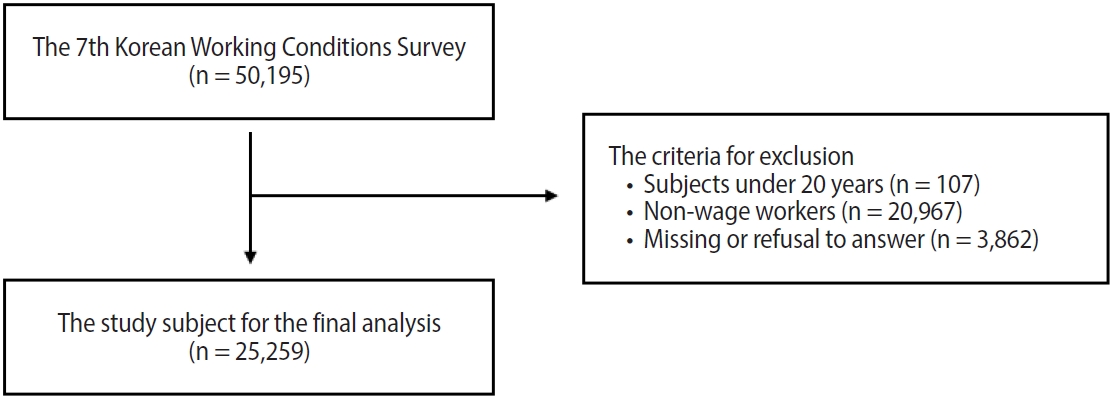
Fig. 2.
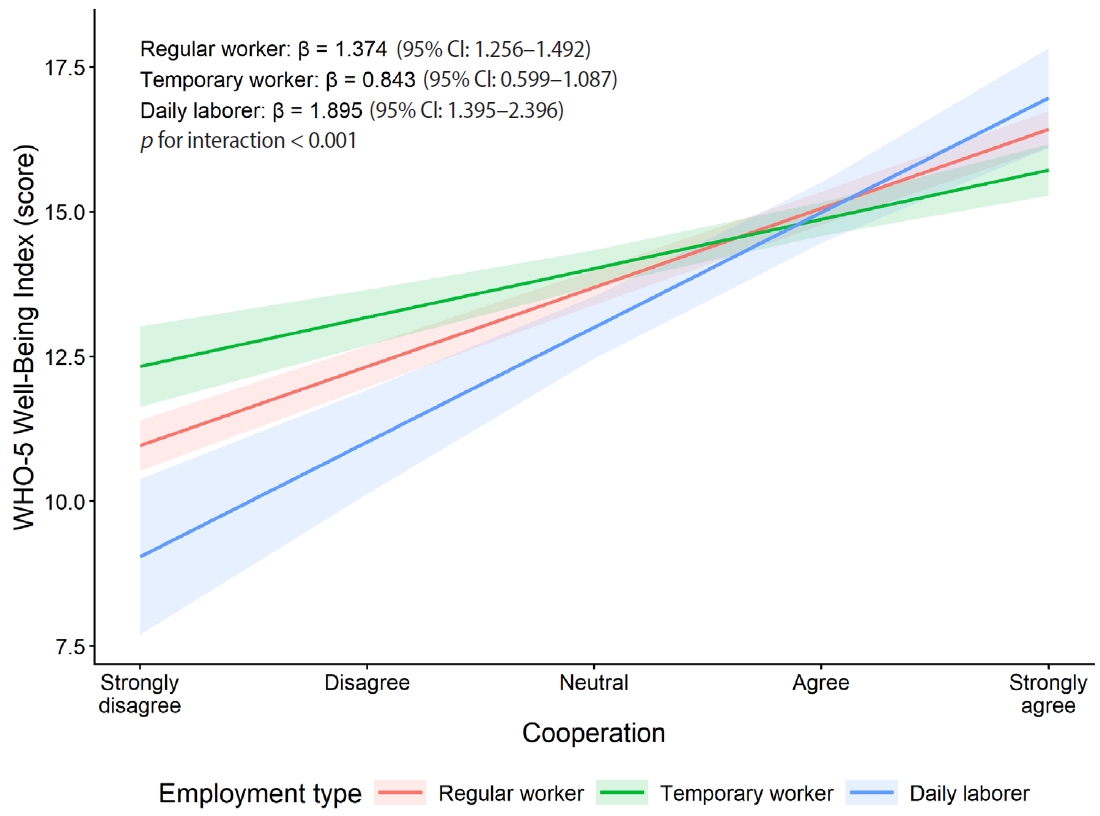
Association between workplace cooperation and the World Health Organization-Five (WHO-5) Well-Being Index by employment type. CI: confidence interval.
Table 1.
Participants’ characteristics by employment type
Values are presented as mean ± standard deviation for continuous variables and number (%) for categorical variables. Differences across employment types were assessed using one-way analysis of variance for continuous variables and chi-squared tests for categorical variables.
Descriptive statistics in Table 1 are presented in unweighted values, whereas sampling weights were applied only in the subsequent regression analyses to yield estimates representative of the South Korean wage-working population. Because the Korean Working Conditions Survey does not release stratum and primary sampling unit identifiers, sampling weights were incorporated only through survey-weighted regression.
Table 2.
Association between cooperation and depressive symptoms by employment type
Model 1 adjusted for sex, age, educational attainment, marital status and monthly income. Model 2 adjusted for occupation type, company size, worktime consistency, weekly work hours and shift work further. Model 3 adjusted for job autonomy, work intensity and customer interaction further. Model 3 is considered the fully adjusted model. All logistic regression models were fitted using survey-weighted quasibinomial regression to account for the Korean Working Conditions Survey sampling weights in each stratum.
OR: odds ratio; CI: confidence interval.
Table 3.
Interaction analysis of workplace cooperation and employment type for depressive symptoms
Model adjusted for sex, age, education, marital status, monthly income, occupation type, workplace size, work time consistency, weekly work hours, shift work, job autonomy, work intensity, and customer interaction.
Multicollinearity was assessed using variance inflation factors. The highest VIF was observed for employment type (1.66), and all VIFs were below the conventional threshold of 10. Model fit was summarized using deviance-based pseudo-R², calculated as 1 − residual deviance/null deviance. The deviance-based pseudo-R² and adjusted pseudo-R² of the fully adjusted survey-weighted quasibinomial model were 0.0401 and 0.0392, respectively.
OR: odds ratio; CI: confidence interval.
- 1. Iliou K, Balaris D, Dokali AM, Fotopoulos V, Kouletsos A, Katsiana A. Exploring the effects of major depressive disorder on daily occupations and the impact of psychotherapy: a literature review. Cureus 2024;16(3):e55831.ArticlePubMedPMC
- 2. Lerner D, Adler DA, Chang H, Lapitsky L, Hood MY, Perissinotto C, et al. Unemployment, job retention, and productivity loss among employees with depression. Psychiatr Serv 2004;55(12):1371–8.ArticlePubMedPMC
- 3. Theorell T, Hammarstrom A, Aronsson G, Traskman Bendz L, Grape T, Hogstedt C, et al. A systematic review including meta-analysis of work environment and depressive symptoms. BMC Public Health 2015;15:738.ArticlePubMedPMCPDF
- 4. Kouvonen A, Oksanen T, Vahtera J, Stafford M, Wilkinson R, Schneider J, et al. Low workplace social capital as a predictor of depression: the Finnish Public Sector Study. Am J Epidemiol 2008;167(10):1143–51.ArticlePubMed
- 5. Liukkonen V, Virtanen P, Kivimaki M, Pentti J, Vahtera J. Social capital in working life and the health of employees. Soc Sci Med 2004;59(12):2447–58.ArticlePubMed
- 6. Kawachi I, Berkman LF. Social ties and mental health. J Urban Health 2001;78(3):458–67.ArticlePubMedPMC
- 7. Bosmans K, Vignola EF, Alvarez-Lopez V, Julia M, Ahonen EQ, Bolibar M, et al. Experiences of insecurity among non-standard workers across different welfare states: a qualitative cross-country study. Soc Sci Med 2023;327:115970.ArticlePubMed
- 8. Gray BJ, Grey C, Hookway A, Homolova L, Davies AR. Differences in the impact of precarious employment on health across population subgroups: a scoping review. Perspect Public Health 2021;141(1):37–49.ArticlePubMedPMCPDF
- 9. Edmonds AT, Sears JM, O'Connor A, Peckham T. The role of nonstandard and precarious jobs in the well-being of disabled workers during workforce reintegration. Am J Ind Med 2021;64(8):667–79.ArticlePubMedPMCPDF
- 10. Honjo K, Iso H, Ikeda A, Yamagishi K, Saito I, Kato T, et al. Cross-sectional association between employment status and self-rated health among middle-aged Japanese women: the influence of socioeconomic conditions and work-life conflict. J Epidemiol 2020;30(9):396–403.ArticlePubMedPMC
- 11. Vanderleyden J, Seo H, Vanroelen C, De Moortel D. Employment quality: a social determinant of health and well-being in a changing labor market in Korea. Soc Indic Res 2025;176:733–70.ArticlePDF
- 12. Lee HE, Kawachi I. Association between unpredictable work schedules and depressive symptoms in Korea. Saf Health Work 2021;12(3):351–8.ArticlePubMedPMC
- 13. Lee YH, Lee YJ, Jang EC, Min YS, Kwon SC. Association between single-person household wage workers in South Korea and insomnia symptoms: the 6th Korean Working Conditions Survey (KWCS). Ann Occup Environ Med 2024;36:e25.ArticlePubMedPMCPDF
- 14. Holm-Hadulla RM, Klimov M, Juche T, Moltner A, Herpertz SC. Well-being and mental health of students during the COVID-19 pandemic. Psychopathology 2021;54(6):291–7.ArticlePubMedPMCPDF
- 15. Yang YJ, Lee J. Association between depressive symptoms and employment type of Korean workers: the Fifth Korean Working Conditions Survey. BMC Public Health 2024;24(1):93.ArticlePubMedPMCPDF
- 16. Kim W, Kim TH, Lee TH, Ju YJ, Chun SY, Park EC. Temporary work and depressive symptoms in South Korean workers. Occup Med (Lond) 2017;67(6):421–4.ArticlePubMed
- 17. Bourdieu P. The forms of capital. In: Richardson J, editor. Handbook of Theory of Research for the Sociology of Education. Westport, CT: Greenwood Press; 1986, 241–58.
- 18. Putnam RD. Bowling Alone: The Collapse and Revival of American Community. New York: Simon & Schuster; 2000.
- 19. Sakai K, Nagata T, Odagami K, Adi NP, Nagata M, Mori K. Inequality in workplace support for various types of precarious workers compared with permanent workers in Japan: a cross-sectional study. J Occup Health 2023;65(1):e12431.ArticlePubMedPMCPDF
REFERENCES
Figure & Data
REFERENCES
Citations
Citations to this article as recorded by 
 Cite
Cite XML Download
- Figure
-
- Related articles
-
- The association between commute time and both presenteeism and absenteeism: a cross-sectional analysis of the 6th Korean Working Conditions Survey
- The relations among workplace verbal abuse, job stress, and good self-rated health among Korean wage workers: Evidence from the 7th Korean Working Conditions Survey (KWCS)
- Association between working ≥10 hours per day and satisfaction with work environment among wage workers in Korea: a cross-sectional study using data from the 7th Korean Working Conditions Survey
- Association between sudden work recall and psychological health issues: a cross-sectional analysis of the 6th Korean Working Conditions Survey
- Association between multiple jobs and physical and psychological symptoms among the Korean working population
Association between workplace cooperation and depressive symptoms differs according to employment type: the 7th Korean Working Conditions Survey
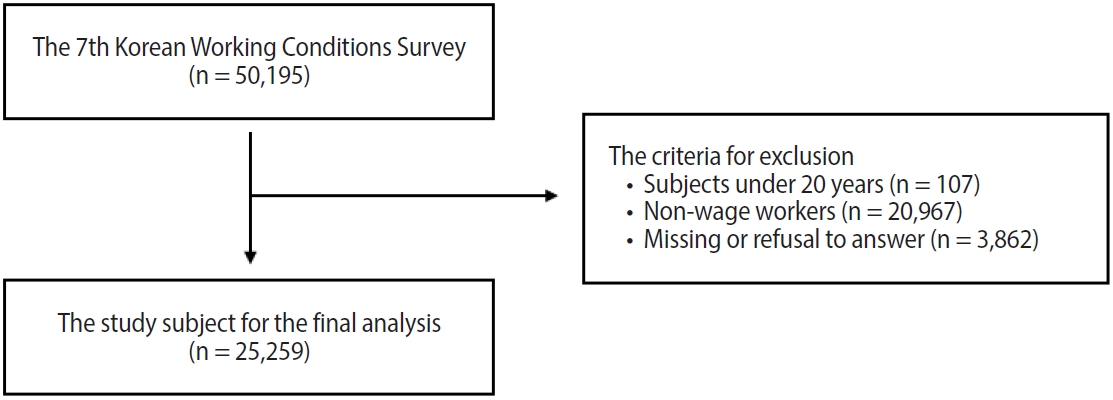
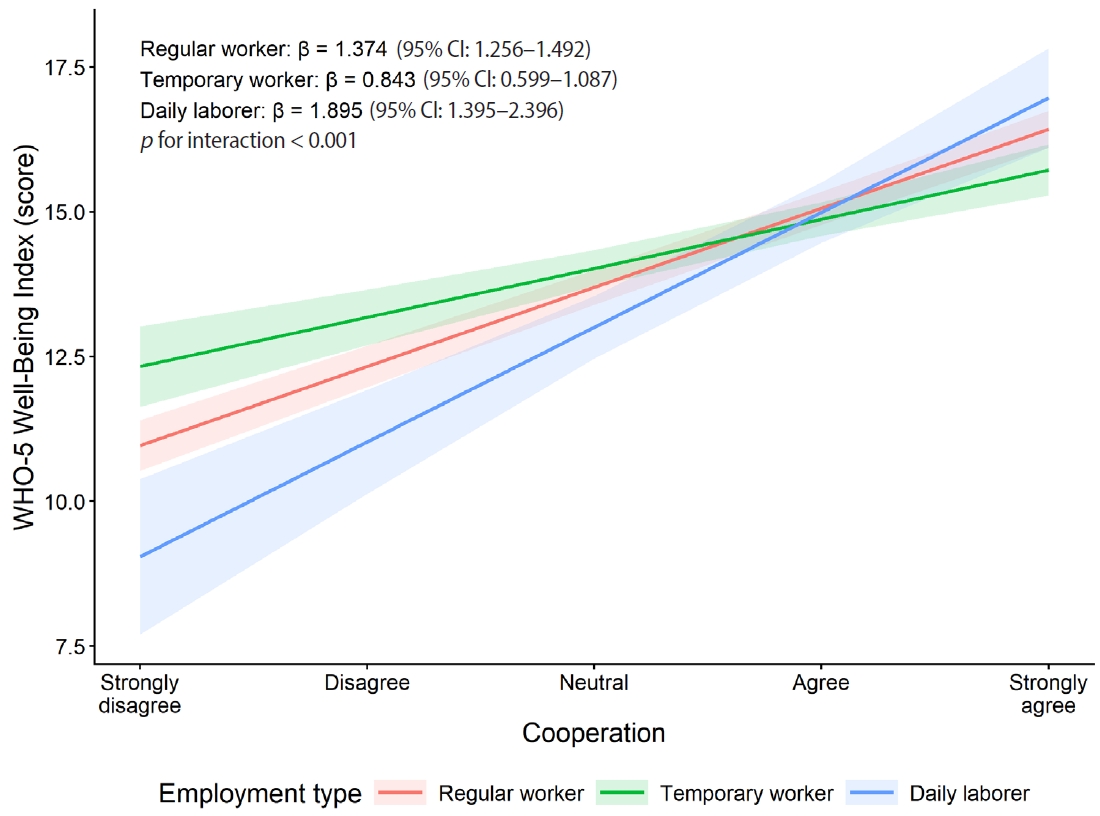
Fig. 1. A schematic diagram for study subject selection.
Fig. 2. Association between workplace cooperation and the World Health Organization-Five (WHO-5) Well-Being Index by employment type. CI: confidence interval.
Fig. 1.
Fig. 2.
Association between workplace cooperation and depressive symptoms differs according to employment type: the 7th Korean Working Conditions Survey
| Characteristic | Regular worker (n = 20,519) | Temporary worker (n = 3,862) | Daily laborers (n = 878) | p-value |
|---|---|---|---|---|
| Sex | <0.001 | |||
| Men | 10,277 (50.1) | 1,194 (30.9) | 507 (57.7) | |
| Women | 10,242 (49.9) | 2,668 (69.1) | 371 (42.3) | |
| Age (years) | 45.7 ± 12.2 | 56.2 ± 18.6 | 56.8 ± 14.7 | <0.001 |
| Education | <0.001 | |||
| High school or less | 6,663 (32.5) | 2,814 (72.9) | 744 (84.7) | |
| University or over | 13,856 (67.5) | 1,048 (27.1) | 134 (15.3) | |
| Marital status (yes) | 15,413 (75.1) | 3,034 (78.6) | 711 (81.0) | <0.001 |
| Monthly income | <0.001 | |||
| < 2 million won | 1,913 (9.3) | 2,618 (67.8) | 472 (53.8) | |
| 2–3 million won | 7,727 (37.7) | 876 (22.7) | 192 (21.9) | |
| 3–4 million won | 6,459 (31.5) | 248 (6.4) | 142 (16.2) | |
| ≥4 million won | 4,420 (21.5) | 120 (3.1) | 72 (8.2) | |
| Occupation type | <0.001 | |||
| White collar | 11,013 (53.7) | 578 (15.0) | 34 (3.9) | |
| Pink collar | 4,418 (21.5) | 1,378 (35.7) | 194 (22.1) | |
| Blue collar | 5,088 (24.8) | 1,906 (49.4) | 650 (74.0) | |
| Workplace size | <0.001 | |||
| <10 | 7,957 (38.8) | 2,259 (58.5) | 600 (68.3) | |
| 10–249 | 10,959 (53.4) | 1,518 (39.3) | 266 (30.3) | |
| ≥250 | 1,603 (7.8) | 85 (2.2) | 12 (1.4) | |
| Work time consistency (yes) | 18,095 (88.2) | 3,230 (83.6) | 437 (49.8) | <0.001 |
| Weekly work hours | <0.001 | |||
| ≤40 hours | 14,490 (70.6) | 3,354 (86.8) | 722 (82.2) | |
| 41–52 hours | 5,163 (25.2) | 399 (10.3) | 130 (14.8) | |
| >52 hours | 866 (4.2) | 109 (2.8) | 26 (3.0) | |
| Shift work (yes) | 1,601 (7.8) | 362 (9.4) | 63 (7.2) | 0.003 |
| Job autonomy (yes) | 5,878 (28.6) | 991 (25.7) | 230 (26.2) | <0.001 |
| Work demand (yes) | 8,202 (40.0) | 1,206 (31.2) | 374 (42.6) | <0.001 |
| Customer interaction (yes) | 7,798 (38.0) | 1,504 (38.9) | 245 (27.9) | <0.001 |
| Depressive symptoms (yes) | 6,610 (32.2) | 1,588 (41.1) | 411 (46.8) | <0.001 |
| Workplace cooperation (good) | 13,706 (66.8) | 2,394 (62.0) | 478 (54.4) | <0.001 |
| Sampling weights | 701.4 ± 524.7 | 917.4 ± 740.6 | 805.8 ± 565.4 | <0.001 |
| Regular worker | Temporary worker | Daily laborer | ||||
|---|---|---|---|---|---|---|
| OR (95% CI) | p-value | OR (95% CI) | p-value | OR (95% CI) | p-value | |
| Model 1 | 0.535 (0.495–0.577) | <0.001 | 0.656 (0.553–0.777) | <0.001 | 0.497 (0.355–0.698) | <0.001 |
| Model 2 | 0.538 (0.498–0.581) | <0.001 | 0.670 (0.565–0.794) | <0.001 | 0.494 (0.350–0.699) | <0.001 |
| Model 3 | 0.538 (0.498–0.581) | <0.001 | 0.666 (0.561–0.790) | <0.001 | 0.479 (0.339–0.679) | <0.001 |
| Variable | OR | 95% CI | p-value |
|---|---|---|---|
| Workplace cooperation | 0.541 | 0.501–0.585 | <0.001 |
| Employment type | |||
| Regular worker | - | - | |
| Temporary worker | 0.962 | 0.817–1.133 | 0.642 |
| Daily laborers | 1.169 | 0.904–1.511 | 0.234 |
| Interaction analysis | |||
| Cooperation × Temporary worker | 1.261 | 1.045–1.522 | 0.016 |
| Cooperation × Daily laborers | 0.912 | 0.651–1.279 | 0.595 |
| Sex (ref = men) | 0.944 | 0.871–1.023 | 0.159 |
| Age | 1.010 | 1.006–1.013 | <0.001 |
| Education (ref = high school or less) | 0.830 | 0.755–0.913 | <0.001 |
| Marital status (ref = no) | 0.960 | 0.873–1.056 | 0.405 |
| Monthly income | |||
| <2 million won | - | - | |
| 2–3 million won | 0.940 | 0.834–1.058 | 0.305 |
| 3–4 million won | 0.871 | 0.762–0.996 | 0.044 |
| ≥4 million won | 0.838 | 0.720–0.975 | 0.022 |
| Occupation type | |||
| White collar | - | - | |
| Pink collar | 0.945 | 0.853–1.047 | 0.283 |
| Blue collar | 1.197 | 1.082–1.324 | <0.001 |
| Workplace size | |||
| <10 | - | - | |
| 10–249 | 0.864 | 0.802–0.931 | <0.001 |
| ≥250 | 0.748 | 0.642–0.871 | <0.001 |
| Work time consistency (ref = no) | 0.803 | 0.729–0.884 | <0.001 |
| Weekly work hours | |||
| ≤ 40 hours | - | - | |
| 41–52 hours | 0.959 | 0.882–1.043 | 0.328 |
| > 52 hours | 1.110 | 0.938–1.314 | 0.223 |
| Shift work (ref = no) | 1.043 | 0.919–1.183 | 0.516 |
| Job autonomy (ref = no) | 0.962 | 0.892–1.037 | 0.314 |
| Work intensity (ref = no) | 1.442 | 1.345–1.547 | <0.001 |
| Customer interaction (ref = no) | 0.980 | 0.910–1.056 | 0.598 |
Table 1. Participants’ characteristics by employment type
Values are presented as mean ± standard deviation for continuous variables and number (%) for categorical variables. Differences across employment types were assessed using one-way analysis of variance for continuous variables and chi-squared tests for categorical variables. Descriptive statistics in Table 1 are presented in unweighted values, whereas sampling weights were applied only in the subsequent regression analyses to yield estimates representative of the South Korean wage-working population. Because the Korean Working Conditions Survey does not release stratum and primary sampling unit identifiers, sampling weights were incorporated only through survey-weighted regression.
Table 2. Association between cooperation and depressive symptoms by employment type
Model 1 adjusted for sex, age, educational attainment, marital status and monthly income. Model 2 adjusted for occupation type, company size, worktime consistency, weekly work hours and shift work further. Model 3 adjusted for job autonomy, work intensity and customer interaction further. Model 3 is considered the fully adjusted model. All logistic regression models were fitted using survey-weighted quasibinomial regression to account for the Korean Working Conditions Survey sampling weights in each stratum. OR: odds ratio; CI: confidence interval.
Table 3. Interaction analysis of workplace cooperation and employment type for depressive symptoms
Model adjusted for sex, age, education, marital status, monthly income, occupation type, workplace size, work time consistency, weekly work hours, shift work, job autonomy, work intensity, and customer interaction. Multicollinearity was assessed using variance inflation factors. The highest VIF was observed for employment type (1.66), and all VIFs were below the conventional threshold of 10. Model fit was summarized using deviance-based pseudo-R², calculated as 1 − residual deviance/null deviance. The deviance-based pseudo-R² and adjusted pseudo-R² of the fully adjusted survey-weighted quasibinomial model were 0.0401 and 0.0392, respectively. OR: odds ratio; CI: confidence interval.


