 KSOEM
KSOEM

Articles
- Page Path
- HOME > Ann Occup Environ Med > Volume 38; 2026 > Article
- Original Article The relations among workplace verbal abuse, job stress, and good self-rated health among Korean wage workers: Evidence from the 7th Korean Working Conditions Survey (KWCS)
-
Youngdo Kim1
 , Jung Wook Kim1, Jung Ho Yang2,3,*
 -
Annals of Occupational and Environmental Medicine 2026;38:e29.
DOI: https://doi.org/10.35371/aoem.2026.38.e29
Published online: July 14, 2026
1Department of Occupational and Environmental Medicine, Institute of Environmental and Occupational Medicine, Inje University Pusan Paik Hospital, Inje University College of Medicine, Busan, Korea
2Department of Preventive Medicine, Chonnam National University Medical School, Hwasun, Korea
3Gwangju Metropolitan City Environmental Health Center, Gwangju, Korea
- *Corresponding author Jung Ho Yang Department of Preventive Medicine, Chonnam National University Medical School, 322 Seoyang-ro, Hwasun 58128, Korea E-mail: st15231@naver.com
• Received: March 20, 2026 • Revised: July 3, 2026 • Accepted: July 4, 2026
© 2026 Korean Society of Occupational & Environmental Medicine
This is an Open Access article distributed under the terms of the Creative Commons Attribution Non-Commercial License (https://creativecommons.org/licenses/by-nc/4.0/) which permits unrestricted non-commercial use, distribution, and reproduction in any medium, provided the original work is properly cited.
- 819 Views
- 21 Download


Abstract
-
Background Workplace verbal abuse has increasingly been recognized as a psychosocial hazard affecting employees’ health. Although its direct psychological consequences have been well documented, the mechanisms through which verbal abuse shapes employees’ self-rated health have been less thoroughly examined. In particular, limited empirical attention has been given to the mediating role of job stress in this relationship. The association between workplace verbal abuse and good self-rated health among Korean wage workers was investigated, and the mediating role of job stress in this relationship was further examined.
-
Methods Data were drawn from the 7th Korean Working Conditions Survey (KWCS), which included a nationally representative sample of 26,427 wage workers aged 20 years or older. Verbal abuse, job stress, and good self-rated health were assessed using structured self-report items. Multivariable logistic regression analyses were performed to evaluate associations among verbal abuse, job stress, and good self-rated health, with adjustments made for individual- and occupational/workplace-related covariates.
-
Results Workplace verbal abuse was significantly associated with higher odds of job stress (odds ratio [OR]: 1.527; 95% confidence interval [CI]: 1.300–1.803; p < 0.001) and lower odds of good self-rated health (OR: 0.641; 95% CI: 0.566–0.726; p < 0.001). Mediation analysis indicated that job stress partially mediated the relationship between verbal abuse and good self-rated health, accounting for 2.38% of the total effect (indirect effect: –0.0021; p < 0.001), while the direct effect of verbal abuse remained significant.
-
Conclusions Workplace verbal abuse was associated with poorer good self-rated health, both directly and indirectly through job stress. These findings highlight the need for organizational interventions and policy-level strategies aimed at reducing verbal aggression and mitigating occupational stress.
BACKGROUND
Workplace verbal abuse has increasingly been recognized as a psychosocial hazard affecting workers’ mental health and organizational well-being.1,2 As a form of violence, it is characterized by repeated negative acts such as insults, threats, humiliation, and derogatory remarks. Considerable variation in its prevalence has been reported across occupational groups, employment types, and demographic characteristics.3-6
Verbal abuse is associated with immediate psychological distress through the undermining of self-esteem, the elicitation of shame, and the threat it poses to personal dignity in the workplace.2,7 Cognitive and emotional resources required to meet work demands are depleted by this psychological assault, resulting in a cumulative burden on mental processing capacity.8 This resource exhaustion may contribute to heightened stress responses as employees struggle to maintain performance. A substantial body of literature has shown that exposure to workplace verbal abuse is strongly associated with job stress.9,10
At the same time, job stress has been increasingly examined as a mediating mechanism linking negative workplace experiences to adverse health outcomes.11,12 Job stress may influence individuals’ perceptions of their health by intensifying the psychological distress experienced in the workplace. Good self-rated health refers to a favorable subjective evaluation of one’s overall health status, reflecting an individual’s perception of physical, mental, and social well-being. Despite its simplicity, self-rated health has been widely recognized as a valid and reliable indicator of current health status.13-16 Accordingly, the presence of good self-rated health is considered an important marker of perceived well-being and overall health status.
Guided by the Transactional Model of Stress and Coping,17 verbal abuse is conceptualized in this study as a stressor that elicits psychological responses—particularly job stress—which may be associated with poorer self-rated health. By positioning job stress as a mediating variable, this work seeks to clarify the mechanisms underlying the relationship between workplace violence and employees’ subjective well-being.
Despite growing recognition of these issues, limited research has examined the relations among verbal abuse, job stress, and self-assessed self-rated health within the Korean workforce using nationally representative data. The 7th wave of the Korean Working Conditions Survey (KWCS) offers an opportunity to address this gap by enabling a comprehensive analysis of the proposed mediation model and, additionally, an examination of the prevalence of verbal abuse across sex, employment type, and job classification, as well as its impact on job stress. The findings of this study are expected to provide important insights for organizational and policy-level efforts to foster supportive work environments and implement effective prevention strategies.
METHODS
Data were drawn from the 7th wave of the KWCS,18 which collected responses from 50,195 employed individuals aged 15 years or older across all 17 provinces of South Korea. The KWCS is a nationally authorized statistical survey conducted by the Occupational Safety and Health Research Institute (OSHRI) under the Ministry of Employment and Labor. Following the KWCS data coding guidelines, non-response and invalid response codes (e.g., ‘8888’ or ‘9999’) were treated as missing values and were not included in main analyses. The study variables relevant to the research objectives were selected from the original dataset. Study subjects with missing values in any of the variables included in the analysis were excluded using a complete-case approach. For the present analysis, the sample was restricted to wage workers aged 20 years or older and 112 participants who aged less than 20 years were excluded to restrict the analysis to the adult working population, as adolescents differ substantially from adult wage workers in their employment patterns and exposure contexts. Non-wage workers (n = 20,040), including unpaid family workers and self-employed individuals, were excluded. After excluding 140 cases with missing values in verbal abuse, stress, and self-rated health along with 3,476 cases with missing data on key study variables, a final analytic sample of 26,427 participants was obtained. The selection process for the final study population is illustrated in Fig. 1. In addition, participants’ characteristics according to inclusion criteria were presented in Supplementary Table 1.
Verbal abuse and job stress
Verbal abuse was classified as a binary variable (“yes” or “no”) based on responses to the question: “Over the last month, during the course of your work, have you been subjected to any of the following?” Job stress was evaluated using the question, “Do you experience stress in your work?” Respondents who answered “always,” “mostly,” or “sometimes” were categorized as having high job stress, whereas those who answered “rarely” or “never” were categorized as having low job stress. As a sensitivity analysis, job stress was alternatively dichotomized using a stricter cutoff: “always” and “mostly” were classified as high job stress, whereas “sometimes,” “rarely,” and “never” were classified as low job stress (Supplementary Fig. 1).
Self-rated health
Self-rated health was assessed using the question, “How is your health in general?” Response options were “very poor,” “poor,” “fair,” “good,” and “very good.” Good self-rated health was defined as responses of “good” or “very good,” whereas responses of “very poor,” “poor,” or “fair” were classified as not having good self-rated health. Self-rated health was thus treated as a binary outcome and the associations of verbal abuse with job stress and good self-rated health were evaluated using binary logistic regression models. To ensure methodological comparability and consistency with the European Working Conditions Survey, the English wording of these key items was sourced directly from the official English codebook provided by the OSHRI. The original Korean wording and official response options for these key survey items are provided in Supplementary Table 2.
Covariates
Covariates were selected a priori based on previous literature as potential confounders of the association between workplace verbal abuse and self-rated health. These variables were classified into individual-level characteristics (i.e., sex, age, educational attainment, marital status, and monthly income) and workplace- and occupation-related characteristics (occupation type, employment type, weekly working hours, and company size). Individual-level covariates have been consistently associated with self-rated health,19 whereas workplace and occupational covariates may influence exposure to adverse working conditions.20 Therefore, these variables were included in the analyses to minimize potential confounding and to better estimate the independent association between workplace verbal abuse, job stress, and self-rated health.
Educational attainment was grouped into three levels: middle school or below, high school, college or over. Marital status was dichotomized as married or single. Monthly income was classified into four groups: less than 2.0 million Korean won (KRW), 2.0–3.0 million KRW, 3.0–4.0 million KRW, and more than 4.0 million KRW. Occupation was classified into three groups: white-collar, pink-collar, and blue-collar occupations. White-collar occupations included managers, professionals and related workers, and clerks. Pink-collar occupations included service and sales workers. Blue-collar occupations included skilled agricultural, forestry, and fishery workers; craft and related trades workers; equipment, machine operating, and assembling workers; elementary workers; and military personnel. Employment type was determined from responses in the wage-worker section of the survey and classified as regular, temporary worker, or daily laborer. Weekly working hours were categorized into three groups: 40 hours or less, from 41 to 52 hours, and more than 52 hours. Company size was classified into three categories: fewer than 5 employees, between 5 and 299 employees, and 300 or more employees. Depressive symptoms were assessed using the World Health Organization (WHO)–5 Well-Being Index. The total score ranges from 0 to 25, with scores of 13 or less indicating a high risk of depressive symptoms, and scores greater than 13 classified as normal.
Participants’ characteristics were presented as number (proportion) according to verbal abuse experience. Pearson’s chi-squared test was conducted to compare the characteristics. The associations of verbal abuse with job stress and good self-rated health were evaluated using logistic regression models. As a sensitivity analysis, Firth’s penalized likelihood logistic regression was performed because workplace verbal abuse was a relatively rare exposure. In each analysis, two regression models were fitted: a crude model including only workplace verbal abuse; model 1 adjusted for individual-level covariates including sex, age, education level, marital status, monthly income, depressive symptoms, and occupational and workplace-related covariates, including occupation type, employment type, weekly working hours, and company size. Multicollinearity among covariates in the fully adjusted models was assessed using variance inflation factors. For categorical variables with more than two levels, generalized variance inflation factors adjusted for degrees of freedom were used. The adjusted variance inflation factor values were all well below the conventional threshold of 10, indicating no evidence of multicollinearity. In addition, a correlation matrix of the main analytical variables was provided in Supplementary Table 3. Mediation analysis was performed using the mediation package in R (R Foundation for Statistical Computing, Vienna, Austria). Logistic regression models were fitted for both the mediator model and the outcome model. In the mediator model, job stress was regressed on workplace verbal abuse and covariates. In the outcome model, good self-rated health was regressed on workplace verbal abuse, job stress, and the same covariates. Covariates included sex, age, education level, marital status, monthly income, depressive symptoms, occupation type, employment type, weekly working hours, and company size. Workplace verbal abuse was specified as the treatment, job stress as the mediator, and good self-rated health as the outcome. The average causal mediation effect, average direct effect, total effect, and proportion mediated were estimated, and confidence intervals were obtained using a quasi-Bayesian Monte Carlo approximation with 10,000 simulations. A separate total-effect logistic regression model was fitted to estimate the association between workplace verbal abuse and good self-rated health without adjustment for job stress.
In addition, occupation- and sex-stratified mediation analyses were conducted to examine whether the mediation pattern differed between men and women. The same mediator and outcome models were fitted separately for male and female participants, excluding sex from the covariates in the sex-specific models. As a sensitivity analysis, the mediation analysis was repeated using an alternative dichotomization of job stress, in which only respondents who answered “always” or “mostly” were classified as having high job stress. All statistical analyses were conducted using R version 4.4.2.
This study was exempted from review by the Institutional Review Board of Chonnam National University Hospital (IRB No. CNUH-EXP-2025-364). All data were fully anonymized before the data were provided.
RESULTS
The characteristics of participants by verbal abuse experience are summarized in Table 1. Except for sex and company size, statistically significant differences were observed across all variables. Participants who experienced verbal abuse were more likely to be those of 20s (13.0% vs. 10.5%) and 50s (27.0% vs. 24.9%), high school education (38.4% vs. 31.4%), single (28.4% vs. 23.8%), and those with a monthly income of 2.0–3.0 million KRW (41.4% vs. 34.1%). Regarding occupational characteristics, pink-collar workers were more prevalent among those reporting verbal abuse (35.7% vs. 23.8%). Day laborers were more represented in the verbal abuse group (6.1% vs. 3.6%), and longer working hours were more common, with 27.9% working 41–52 hours per week and 8.1% working more than 52 hours per week, compared with 22.0% and 3.8%, respectively, among those without verbal abuse experience. Participants who experienced verbal abuse reported poorer good self-rated health, with a higher proportion rating their health as fair (37.8% vs. 27.4%) or poor (5.2% vs. 4.1%) and a lower proportion reporting good health (47.4% vs. 58.3%). In addition, depressive symptom (49.6% vs. 33.8%) and stress (84.9% vs. 78.0%) were more prevalent among individuals who experienced verbal abuse.
The results of logistic regression analysis estimating the associations of workplace verbal abuse with job stress and good self-rated health are presented in Table 2. Two regression models were estimated. The crude model was unadjusted; model 1 was adjusted for individual-level and workplace- and occupation-related covariates. Workplace verbal abuse was significantly associated with higher odds of job stress and lower odds of good self-rated health in all models. In the crude model, workers exposed to verbal abuse had higher odds of reporting job stress (odds ratio [OR]: 1.588; 95% confidence interval [CI]: 1.358–1.868; p < 0.001) and lower odds of reporting good self-rated health (OR: 0.621; 95% CI: 0.553–0.698; p < 0.001). The associations remained statistically significant after adjustment for individual-level and workplace- and occupation-related covariates in Model 1 (job stress: OR: 1.527; 95% CI: 1.300–1.803; good self-rated health: OR: 0.641; 95% CI: 0.566–0.726).
The mediating effect of job stress on the relationship between verbal abuse and good self-rated health was evaluated. The total effect of verbal abuse on good self-rated health was statistically significant (total effect: –0.0882; p < 0.001). The direct effect accounted for most of this association (direct effect: –0.0861; p < 0.001), and the indirect effect remained statistically significant (indirect effect: –0.0021; p < 0.001) (Fig. 2).
Fig. 3 illustrates the results of sex-stratified mediation analyses. Among male workers, the total effect of workplace verbal abuse on good self-rated health was statistically significant (total effect: −0.0664; p < 0.001). The indirect effect through job stress was also significant (indirect effect: −0.0014; p <0.05), with a mediated proportion of 1.96%. Among female workers, the total effect was also statistically significant (total effect: −0.1087; p < 0.001). The indirect effect through job stress remained significant (indirect effect: −0.0028; p = 0.001), accounting for 2.48% of the total effect.
Fig. 4 presents the results of occupation-stratified mediation analyses. Among white-collar workers, the total effect of workplace verbal abuse on good self-rated health was statistically significant (total effect: −0.0989; p < 0.001). The indirect effect through job stress was also significant (indirect effect: −0.0024; p < 0.05), with a mediated proportion of 2.44%. Among pink-collar workers, the total effect was statistically significant (total effect: −0.1026; p < 0.001), whereas the indirect effect through job stress was not statistically significant (indirect effect: −0.0017; p = 0.159). The mediated proportion was 1.59%. Among blue-collar workers, the total effect was statistically significant (total effect: −0.0649; p < 0.01). However, the indirect effect through job stress was not statistically significant (indirect effect: −0.0011; p = 0.127), with a mediated proportion of 1.60%.
DISCUSSION
Evidence of an association between exposure to workplace verbal abuse and levels of job stress among South Korean wage workers was demonstrated in this study. Through multivariable logistic regression analyses, it was found that even after adjustment for individual- and workplace and occupational covariates, individuals exposed to verbal abuse were significantly more likely to experience high job stress. These findings are consistent with prior research indicating that verbal abuse is associated with job stress.9,10 In particular, workers exposed to workplace verbal abuse had significantly higher odds of reporting job stress (OR: 1.527; 95% CI: 1.300–1.803) than those without such exposure, even after full adjustment, consistent with the sensitivity analysis using Firth's penalized logistic regression (Supplementary Table 4). This finding is consistent with previous studies suggesting that workplace verbal abuse is associated with increased psychological strain and adverse psychosocial outcomes.8
A statistically significant indirect association through job stress was also found, offering insight into the mechanism through which workplace verbal abuse is associated with workers’ good self-rated health. Mediation analysis indicated that workplace verbal abuse was associated with good self-rated health both directly and indirectly through job stress. However, the proportion mediated by job stress was relatively small (2.38%), suggesting that most of the observed association might be due to the direct association between workplace verbal abuse and good self-rated health. These results are consistent with a partial mediation pattern, in which job stress may represent one possible pathway linking verbal abuse and good self-rated health. This pattern can be understood using the framework of Lazarus & Folkman’s (1984) Transactional Model of Stress and Coping.17 Within this framework, workplace verbal abuse may be appraised as a stressful experience, and perceived inadequacy of coping resources may be associated with higher levels of job stress. Increased job stress may, in turn, be related to less favorable good self-rated health. Although these processes cannot be directly examined using cross-sectional data, the observed pattern of associations is broadly consistent with this theoretical perspective.17
The findings further suggest that job stress may be associated with the relationship between workplace verbal abuse and good self-rated health, although the magnitude of the indirect association was modest. One possible interpretation is that workplace verbal abuse is associated with psychological distress and adverse workplace experiences, while job stress may represent one of several factors related to workers’ perceptions of good self-rated health. This dual mechanism aligns with established theoretical perspectives. From the perspective of the Conservation of Resources theory,21,22 workplace verbal abuse may represent a potential threat to valued psychological resources such as self-esteem and professional identity. Resource-related concerns may be associated with higher levels of job stress and less favorable good self-rated health. Empirical evidence supports this interpretation. For example, Cao et al.23 reported that workplace verbal abuse among medical staff increased emotional exhaustion, which subsequently mediated declines in job engagement and job satisfaction. Previous studies have suggested that chronic exposure to psychosocial stressors may be associated with adverse physical and psychological health outcomes.24-26 Although the present study did not assess biological mechanisms directly, these theoretical perspectives provide a possible framework for understanding the observed associations among workplace verbal abuse, job stress, and good self-rated health.
Additional stratified analyses revealed some heterogeneity across subgroups. The indirect association through job stress was observed in both men and women, although the mediated proportion was slightly higher among women (2.48%) than among men (1.96%). Furthermore, occupation-stratified analyses indicated that the indirect association was statistically significant among white-collar workers but not among pink-collar or blue-collar workers. These findings suggest that the associations among workplace verbal abuse, job stress, and self-rated health may differ according to worker characteristics and occupational contexts.
The present study used good self-rated health assessed using a single-item measure. Self-rated health is a well-validated predictor of morbidity and mortality and remains associated with adverse health outcomes even after controlling for physician-diagnosed diseases and objective health indicators.27-29 Therefore, good self-rated health can be considered an indicator of overall health status in population-based studies and has been widely used in medical and epidemiological research. The lower likelihood of reporting good self-rated health among workers exposed to workplace verbal abuse may thus reflect health-related consequences.
This study is subject to several limitations. First, the reliance on self-reported measures introduces the possibility of recall or reporting bias. Second, unmeasured confounding variables, including personality traits or prior mental health history, may have influenced the observed associations. Third, the cross-sectional nature of the data might restrict causal inference. Reverse causality cannot be ruled out, as workers with higher levels of job stress or poorer self-rated health may be more likely to perceive workplace interactions as verbal abuse. The findings of the current work thus should be interpreted as associations rather than causal relationships, and longitudinal research is needed to assess the directionality of these relationships. Fourth, because all variables were assessed through self-reported measures collected from the same respondents at a single time point, the possibility of common method bias cannot be excluded. As a result, the observed associations may have been partially inflated by shared measurement characteristics. Fifth, key residual confounders including innate depressive traits or history of mental illness were not assessed in the present work. Sixth, although the indirect effect through job stress was statistically significant, the mediated proportion was small (approximately 2%–3%), and such significance may partly reflect the large sample size. The indirect pathway should thus be interpreted as practically limited, and most of the association between workplace verbal abuse and good self-rated health appears to be explained by the direct pathway or by other unmeasured pathways. Consequently, associations observed in the present work may have been influenced by unmeasured individual characteristics rather than reflecting independent relationships among the study variables. Seventh, workplace verbal abuse and job stress were measured using single-item questions, which may not fully reflect the nature of constructs. The potential for measurement error should be acknowledged; thus, future research using validated multi-item scales is warranted to extend the present findings. Eighth, a limitation concerns the use of a complete-case approach for handling missing data. As shown in Supplementary Table 1, participants excluded because of missing values differed significantly from those included in the final analytic sample across several characteristics, including age, education level, monthly income, occupation, employment type, self-rated health, and depressive symptoms. Because the excluded and included participants were not comparable, the possibility of selection bias arising from the complete-case analysis cannot be ruled out, and the findings may not be fully generalizable to the entire working population. Future studies using approaches such as multiple imputation are warranted to address this limitation.
CONCLUSIONS
In the present work, workplace verbal abuse was associated with poorer good self-rated health among Korean wage workers, both directly and indirectly through its association with job stress. Job stress may represent one possible pathway linking workplace verbal abuse and good self-rated health, although the indirect association was modest in magnitude. The Transactional Model of Stress and Coping and the Conservation of Resources theory offer one plausible framework for interpreting these observed associations. Because the data were cross-sectional, these findings should be interpreted as statistical associations rather than causal or mechanistic relationships, and longitudinal research is needed to clarify their directionality. These findings may contribute to the literature on workplace violence by describing the observed associations among verbal abuse, job stress, and good self-rated health.
Abbreviations
CI
confidence interval
KWCS
Korean Working Conditions Survey
OR
odds ratio
OSHRI
Occupational Safety and Health Research Institute
WHO
World Health Organization
-
Competing interests
The authors declare that they have no competing interests.
-
Author contributions
Conceptualization: Yang JH. Data curation: Kim JW. Formal analysis: Kim JW. Translation: Kim JW, Yang JH, Kim Y. Reconciliation: Kim JW, Yang JH, Kim Y. Writing - original draft: Kim JW. Writing - review & editing: Yang JH, Kim Y.
-
Acknowledgments
During the preparation of this work, the authors used ChatGPT (OpenAI, San Francisco, CA, USA) in order to assist with language editing and manuscript preparation. After using this tool, the authors reviewed and edited the content and take full responsibility for the content of the published article.
NOTES
SUPPLEMENTARY MATERIAL
Supplementary Table 1.
Comparison of baseline characteristics between complete and incomplete cases.
Supplementary Table 2.
Original Korean wording and English translation of the key survey items from the 7th Korean Working Conditions Survey (KWCS).
Supplementary Table 3.
Correlation matrix of the main variables in the final analysis.
Supplementary Table 4.
Associations of workplace verbal abuse with job stress and good self-rated health using Firth’s penalized logistic regression.
Supplementary Fig. 1.
A mediation model of the relations of verbal abuse, job stress, and good self-rated health: sensitivity analysis using an alternative dichotomization of job stress (always/mostly vs. sometimes/rarely/never).
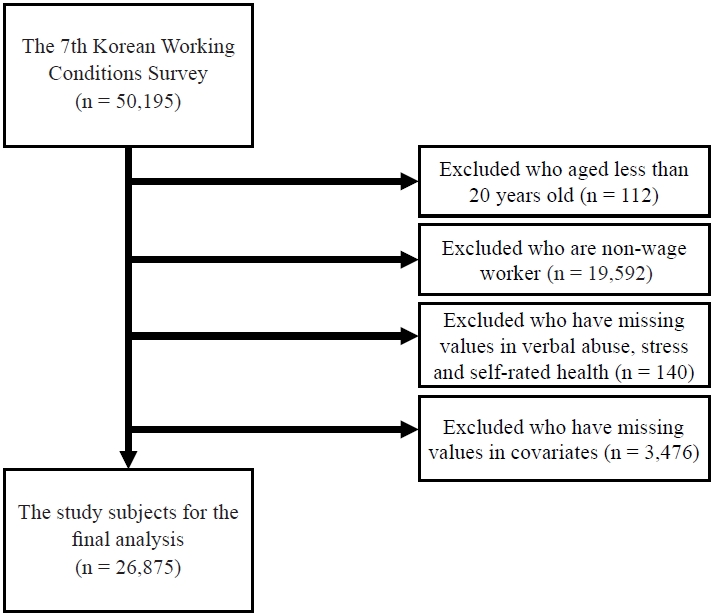
Fig. 2.
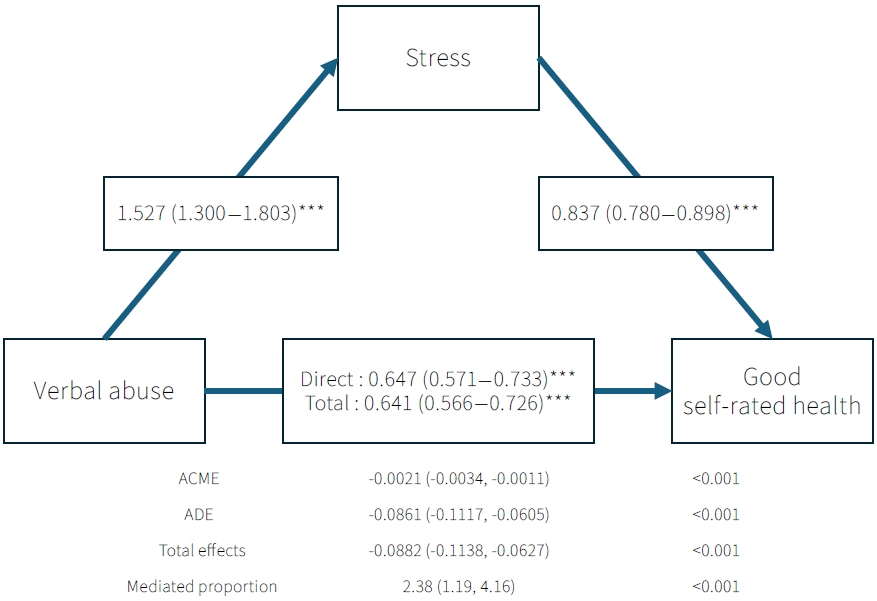
A mediation model of the relations of verbal abuse, job stress, and good self-rated health. ACME: average causal mediation effect; ADE: average direct effect. ***p < 0.001.
Fig. 3.
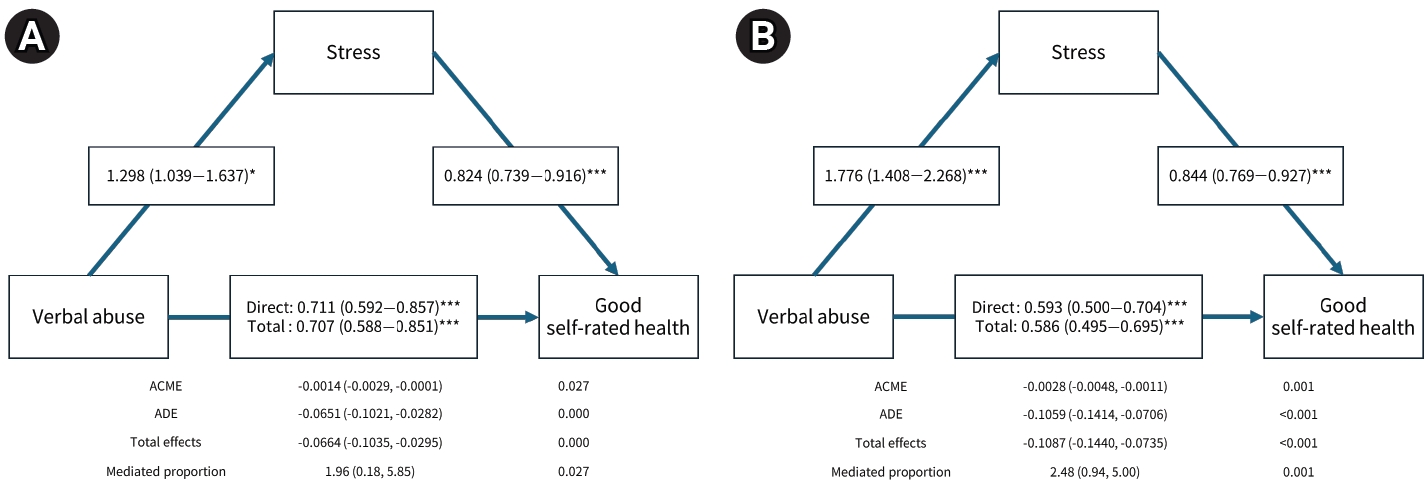
A mediation model of the relations of verbal abuse, job stress, and good self-rated health. Sex-stratified mediation analyses: (A) male and (B) female. ACME: average causal mediation effect; ADE: average direct effect. *p < 0.05, ***p < 0.001.
Fig. 4.
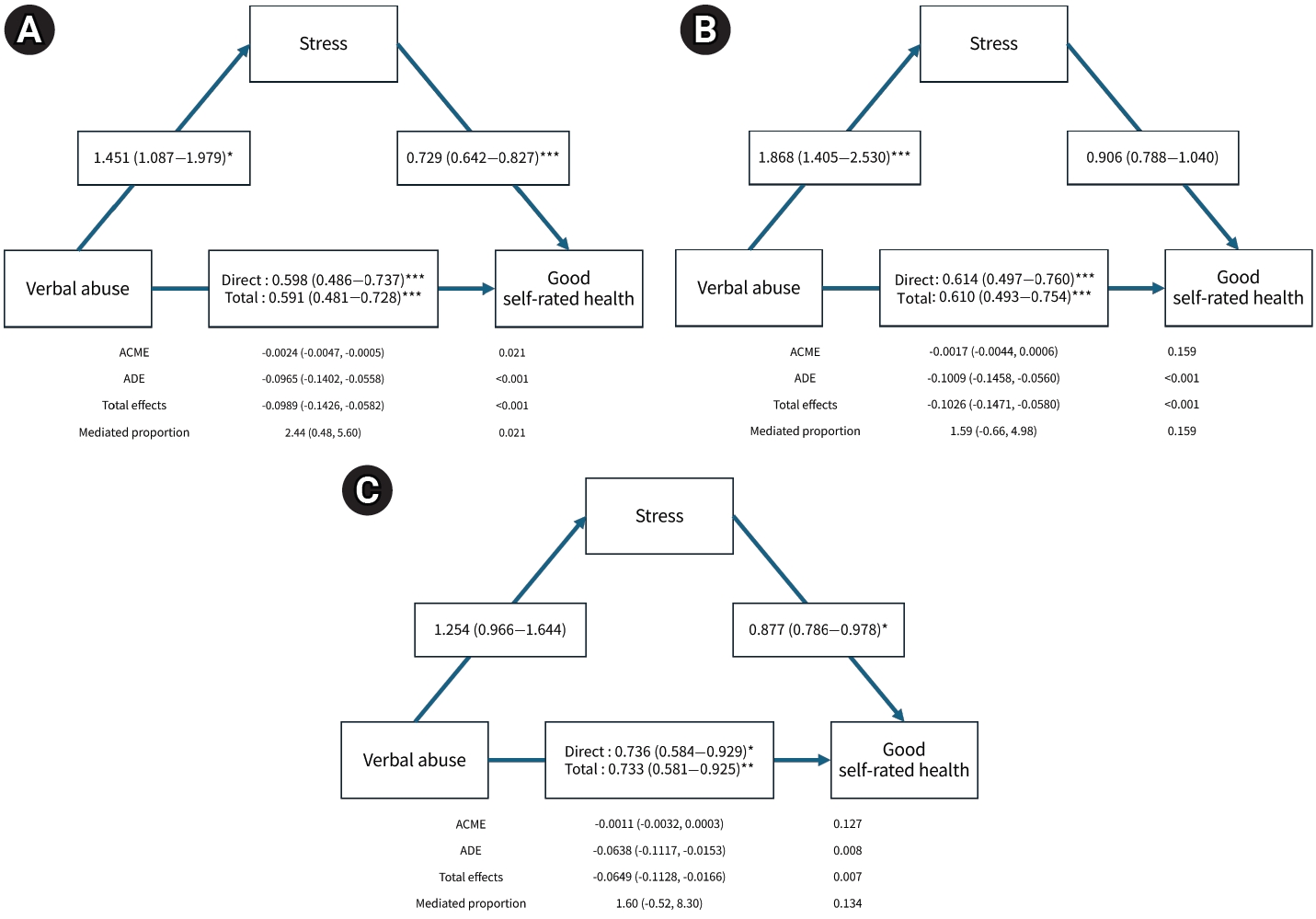
A mediation model of the relations of verbal abuse, job stress, and good self-rated health. Occupation-stratified mediation analyses: (A) white-collar worker, (B) pink-collar worker, and (C) blue-collar worker. ACME: average causal mediation effect; ADE: average direct
effect. *p < 0.05, **p < 0.01, ***p < 0.001.
Table 1.
Characteristics of participants according to verbal abuse experience
| Characteristic | Total (n = 26,427) | Verbal abuse experience | p-value | |
|---|---|---|---|---|
| No (n = 25,207) | Yes (n = 1,220) | |||
| Sex | 0.928 | |||
| Male | 12,357 (46.8) | 11,785 (46.8) | 572 (46.9) | |
| Female | 14,070 (53.2) | 13,422 (53.2) | 648 (53.1) | |
| Age (years) | 47.9 ± 14.2 | 48.0 ± 14.3 | 46.4 ± 13.3 | 0.004 |
| 20–29 | 2,797 (10.6) | 2,639 (10.5) | 158 (13.0) | |
| 30–39 | 5,663 (21.4) | 5,402 (21.4) | 261 (21.4) | |
| 40–49 | 5,625 (21.3) | 5,379 (21.3) | 246 (20.2) | |
| 50–59 | 6,604 (25.0) | 6,274 (24.9) | 330 (27.0) | |
| ≥60 | 5,738 (21.7) | 5,513 (21.9) | 225 (18.4) | |
| Educational level | <0.001 | |||
| Middle school or below | 2,573 (9.7) | 2,499 (9.9) | 74 (6.1) | |
| High school | 8,381 (31.7) | 7,912 (31.4) | 469 (38.4) | |
| College or over | 15,473 (58.5) | 14,796 (58.7) | 677 (55.5) | |
| Marital status | <0.001 | |||
| Married | 20,082 (76.0) | 19,208 (76.2) | 874 (71.6) | |
| Single | 6,345 (24.0) | 5,999 (23.8) | 346 (28.4) | |
| Monthly income (million KRW) | <0.001 | |||
| <2.0 | 5,610 (21.2) | 5,360 (21.3) | 250 (20.5) | |
| 2.0–3.0 | 9,109 (34.5) | 8,604 (34.1) | 505 (41.4) | |
| 3.0–4.0 | 7,004 (26.5) | 6,698 (26.6) | 306 (25.1) | |
| ≥4.0 | 4,704 (17.8) | 4,545 (18.0) | 159 (13.0) | |
| Occupation | <0.001 | |||
| White-collar workera | 11,908 (45.1) | 11,470 (45.5) | 438 (35.9) | |
| Pink-collar worker | 6,425 (24.3) | 5,990 (23.8) | 435 (35.7) | |
| Blue-collar worker | 8,094 (30.6) | 7,747 (30.7) | 347 (28.4) | |
| Type of employment | <0.001 | |||
| Regular | 21,173 (80.1) | 20,179 (80.1) | 994 (81.5) | |
| Temporary | 4,264 (16.1) | 4,112 (16.3) | 152 (12.5) | |
| Day laborers | 990 (3.7) | 916 (3.6) | 74 (6.1) | |
| Weekly working hours | <0.001 | |||
| ≤40 | 19,486 (73.7) | 18,705 (74.2) | 781 (64.0) | |
| 41–52 | 5,890 (22.3) | 5,550 (22.0) | 340 (27.9) | |
| >52 | 1,051 (4.0) | 952 (3.8) | 99 (8.1) | |
| Company size | 0.136 | |||
| <5 workers | 6,152 (23.3) | 5,896 (23.4) | 256 (21.0) | |
| 5–299 workers | 18,833 (71.3) | 17,934 (71.1) | 899 (73.7) | |
| ≥300 workers | 1,442 (5.5) | 1,377 (5.5) | 65 (5.3) | |
| Self-rated health status | <0.001 | |||
| Very poor | 153 (0.6) | 151 (0.6) | 2 (0.2) | |
| Poor | 1,094 (4.1) | 1,030 (4.1) | 64 (5.2) | |
| Fair | 7,365 (27.9) | 6,904 (27.4) | 461 (37.8) | |
| Good | 15,269 (57.8) | 14,691 (58.3) | 578 (47.4) | |
| Very good | 2,546 (9.6) | 2,431 (9.6) | 115 (9.4) | |
| Depression (yes) | 9,134 (34.6) | 8,529 (33.8) | 605 (49.6) | <0.001 |
| Stress (yes) | 20,697 (78.3) | 19,661 (78.0) | 1,036 (84.9) | <0.001 |
Values are presented as number (%) or mean ± SD.
KRW: Korean won; SD: standard deviation.
aWhite-collar: technicians, experts, and paraprofessionals; pink-collar: service, sales workers, and clerical support; blue-collar: engineers, equipment, machine operation and assembly workers, and simple-labor workers.
Table 2.
Associations of workplace verbal abuse with job stress and good self-rated health
- 1. Alsaqat RT, Alhassan AK, Al Sweleh FS. Verbal workplace violence in the health sector in Saudi Arabia: a cross-sectional study. Medicine (Baltimore) 2023;102(51):e36760.ArticlePubMedPMC
- 2. Yun JY, Shim G, Jeong B. Verbal abuse related to self-esteem damage and unjust blame harms mental health and social interaction in college population. Sci Rep 2019;9(1):5655.ArticlePubMedPMCPDF
- 3. Onal O, Evcil FY, Batmaz K, Coban B, Dogan E. Systematic review and meta-analysis of verbal and physical violence against healthcare workers in the Eastern Mediterranean Region. East Mediterr Health J 2023;29(10):819–30.ArticlePubMed
- 4. Lee SH. Effect of burnout, verbal abuse experience, and social support on job embeddedness in the small and medium sized hospital nurses. J Digit Converg 2018;16(12):477–87.
- 5. Syyrila T, Vanttinen M, Koskiniemi S, Mantymaa M, Ranta J, Saila M, et al. Verbal abuse of service users by professionals in social services: qualitative analysis of reported events in Finland. J Soc Work Pract 2024;38(3):317–31.Article
- 6. Wang Q, Yang YP, Li ZY, Yu FY, He Y, Zhang M, et al. Prevalence and associated factor of verbal abuse against nurses: a systematic review. Int Nurs Rev 2025;72(1):e13095.ArticlePubMed
- 7. Guay S, Goncalves J, Jarvis J. Verbal violence in the workplace according to victims’ sex: a systematic review of the literature. Aggress Violent Behav 2014;19(5):572–8.Article
- 8. Cheng P, Jiang J, Xie S, Liu Z. Dysfunctional customer behavior influences on employees' emotional labor: the moderating roles of customer orientation and perceived organizational support. Front Psychol 2022;13:966845.ArticlePubMedPMC
- 9. Afshari Saleh L, Niroumand S, Dehghani Z, Afshari Saleh T, Mousavi SM, Zakeri H. Relationship between workplace violence and work stress in the emergency department. J Inj Violence Res 2020;12(2):183–90.PMC
- 10. Oh EJ, Kim YS. A study on the relationship between upper-scale general hospital nurses’ experience of verbal abuse and job stress. Korean J Occup Health Nurs 2015;24(3):173–82.Article
- 11. Kim JS. The relationship between workplace bullying and social worker burnout: verification of the mediating effect of job stress. J Korean Soc Welf Adm 2023;25(1):1–28.
- 12. Pamuk M. The mediator role of job stress in the relationship between the mental workload and burnout of school counsellors. Br J Guid Counc 2025;53(2):336–50.Article
- 13. Cachioni M, Cipolli GC, Borim FS, Batistoni SS, Yassuda MS, Neri AL, et al. Factors associated with positive self-rated health: comparing older adults in Brazil and in Portugal. Front Public Health 2021;9:650294.ArticlePubMedPMC
- 14. Erhag HF. Good self-rated health as an indicator of personal capability in old age. In: Erhag HF, Nilsson UL, Sterner TR, Skoog I, editors. A Multidisciplinary Approach to Capability in Age and Ageing. Cham, Switzerland: Springer Nature Switzerland AG; 2022, 51–63.
- 15. Kang H, Kim DH. Socioeconomic, health, and social connectedness factors associated with self-rated health of octogenarians and nonagenarians in South Korea: urban and rural comparison. BMC Public Health 2024;24(1):3477.ArticlePubMedPMCPDF
- 16. Kristenson M, Olsson AG, Kucinskiene Z. Good self-rated health is related to psychosocial resources and a strong cortisol response to acute stress: the LiVicordia study of middle-aged men. Int J Behav Med 2005;12(3):153–60.ArticlePubMed
- 17. Lazarus RS, Folkman S. Stress, Appraisal, and Coping. New York: Springer; 1984.
- 18. Cho Y. Data resource profile: the Korean Working Conditions Survey (KWCS). Ann Occup Environ Med 2023;35:e49.ArticlePubMedPMCPDF
- 19. Moor I, Spallek J, Richter M. Explaining socioeconomic inequalities in self-rated health: a systematic review of the relative contribution of material, psychosocial and behavioural factors. J Epidemiol Community Health 2017;71(6):565–75.ArticlePubMed
- 20. Dieker AC, IJzelenberg W, Proper KI, Burdorf A, Ket JC, van der Beek AJ, et al. The contribution of work and lifestyle factors to socioeconomic inequalities in self-rated health: a systematic review. Scand J Work Environ Health 2019;45(2):114–25.ArticlePubMed
- 21. Demerouti E. Job demands-resources and conservation of resources theories: how do they help to explain employee well-being and future job design? J Bus Res 2025;192:115296.Article
- 22. Hobfoll SE. Conservation of resources: a new attempt at conceptualizing stress. Am Psychol 1989;44(3):513–24.ArticlePubMed
- 23. Cao Y, Gao L, Fan L, Zhang Z, Liu X, Jiao M, et al. Effects of verbal violence on job satisfaction, work engagement and the mediating role of emotional exhaustion among healthcare workers: a cross-sectional survey conducted in Chinese tertiary public hospitals. BMJ Open 2023;13(3):e065918.ArticlePubMedPMC
- 24. Alotiby A. Immunology of stress: a review article. J Clin Med 2024;13(21):6394.ArticlePubMedPMC
- 25. McEwen BS, Seeman T. Protective and damaging effects of mediators of stress: elaborating and testing the concepts of allostasis and allostatic load. Ann N Y Acad Sci 1999;896:30–47.ArticlePubMed
- 26. O'Toole T, Armitage CJ, van Tongeren M, Dienes KA. Primary and secondary allostatic processes in the context of high-stress work: a multigroup moderation from the English longitudinal study of ageing. Psychoneuroendocrinology 2025;171:107193.ArticlePubMed
- 27. DeSalvo KB, Bloser N, Reynolds K, He J, Muntner P. Mortality prediction with a single general self-rated health question: a meta-analysis. J Gen Intern Med 2006;21(3):267–75.ArticlePubMedPMC
- 28. Idler EL, Benyamini Y. Self-rated health and mortality: a review of twenty-seven community studies. J Health Soc Behav 1997;38(1):21–37.ArticlePubMed
- 29. Jylha M. What is self-rated health and why does it predict mortality? Towards a unified conceptual model. Soc Sci Med 2009;69(3):307–16.ArticlePubMedPMC
REFERENCES
Figure & Data
REFERENCES
Citations
Citations to this article as recorded by 
 Cite
Cite XML Download
- Figure
-
- Related articles
-
- Association between workplace cooperation and depressive symptoms differs according to employment type: the 7th Korean Working Conditions Survey
- Work-life balance and effort-reward imbalance, and their interaction, associated with presenteeism among Korean wage workers: Based on 6th Korean working conditions survey
- Association between single-person household wage workers in South Korea and insomnia symptoms: the 6th Korean Working Conditions Survey (KWCS)
The relations among workplace verbal abuse, job stress, and good self-rated health among Korean wage workers: Evidence from the 7th Korean Working Conditions Survey (KWCS)
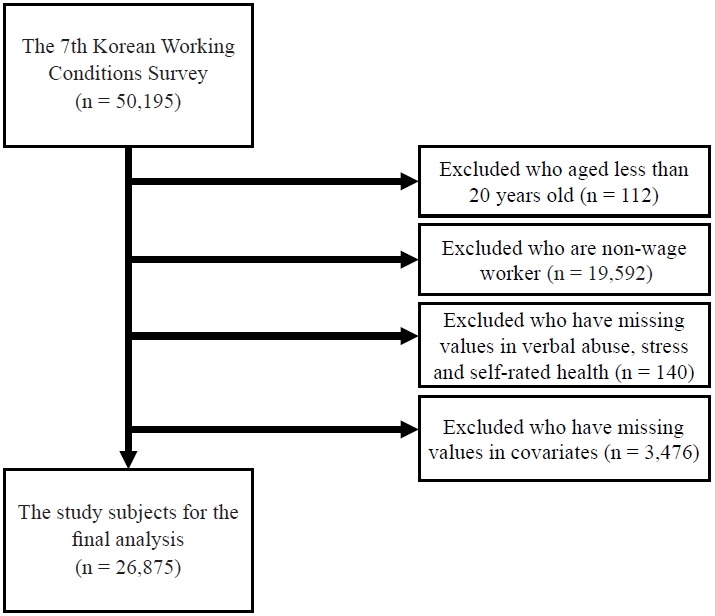
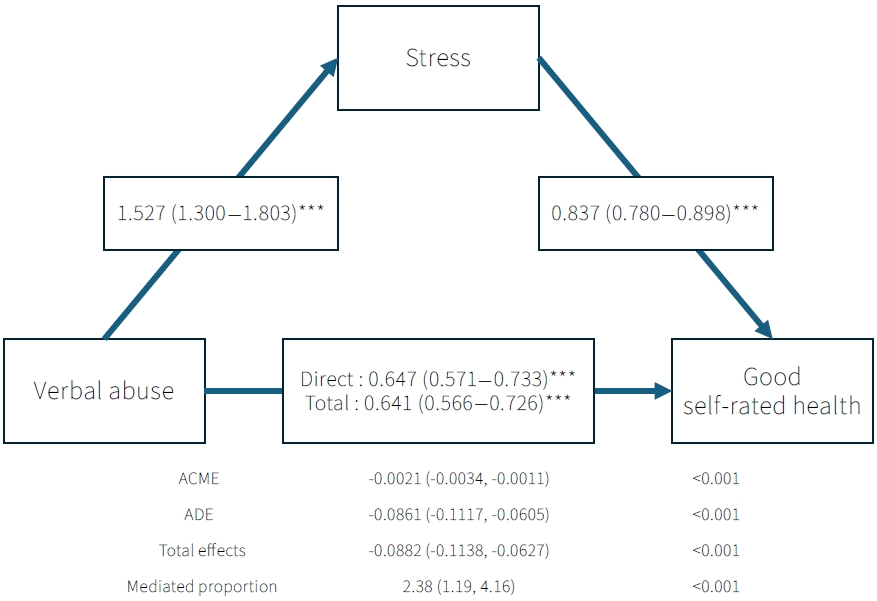
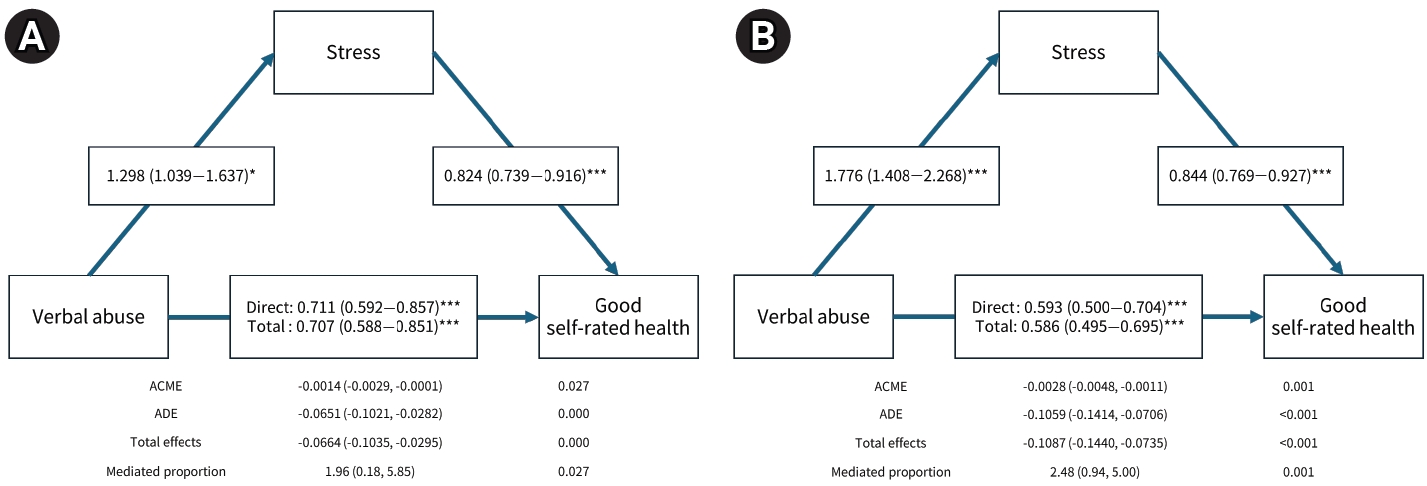
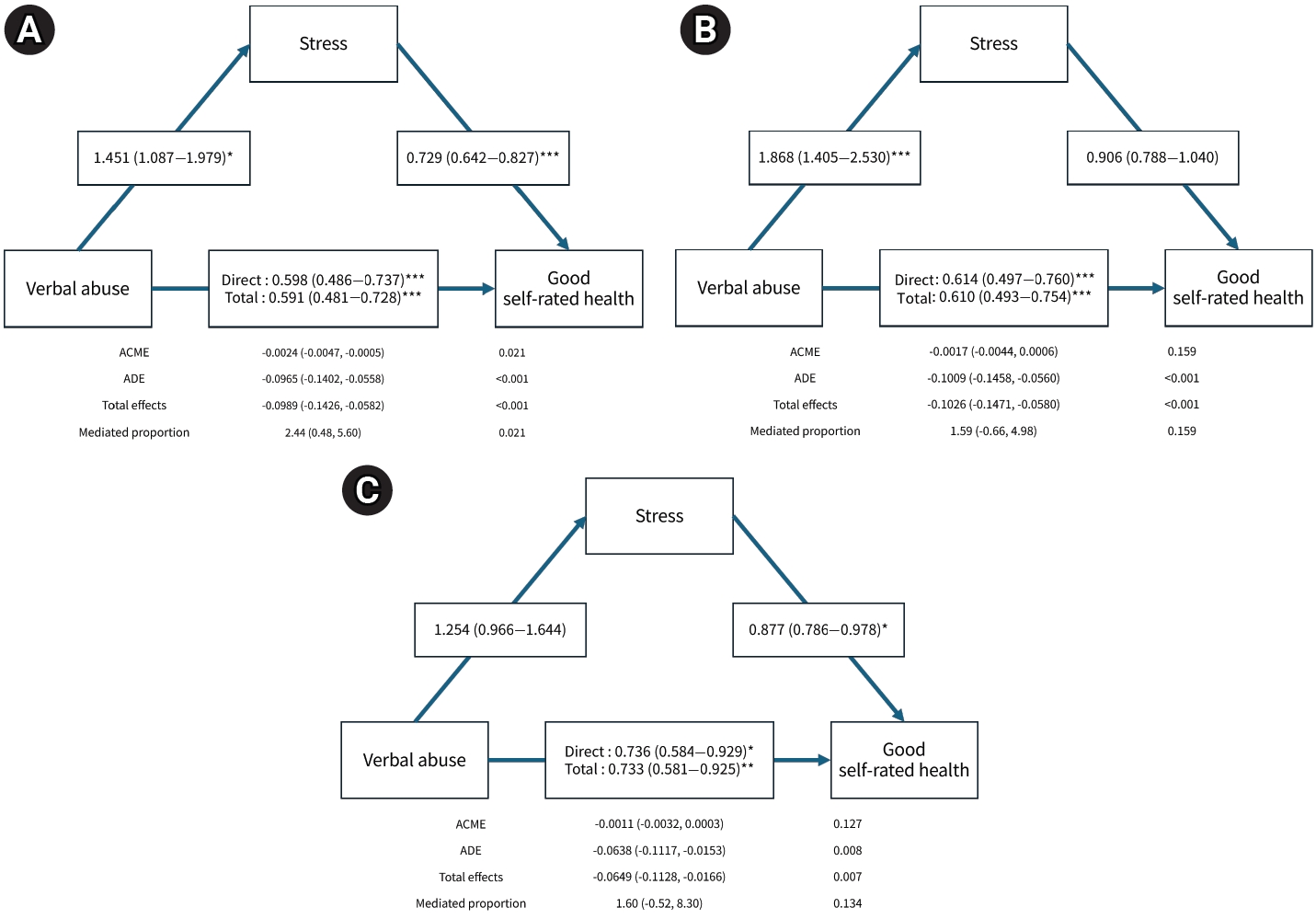
Fig. 1. Schematic diagram of study subject selection.
Fig. 2. A mediation model of the relations of verbal abuse, job stress, and good self-rated health. ACME: average causal mediation effect; ADE: average direct effect. ***p < 0.001.
Fig. 3. A mediation model of the relations of verbal abuse, job stress, and good self-rated health. Sex-stratified mediation analyses: (A) male and (B) female. ACME: average causal mediation effect; ADE: average direct effect. *p < 0.05, ***p < 0.001.
Fig. 4. A mediation model of the relations of verbal abuse, job stress, and good self-rated health. Occupation-stratified mediation analyses: (A) white-collar worker, (B) pink-collar worker, and (C) blue-collar worker. ACME: average causal mediation effect; ADE: average direct
effect. *p < 0.05, **p < 0.01, ***p < 0.001.
Fig. 1.
Fig. 2.
Fig. 3.
Fig. 4.
The relations among workplace verbal abuse, job stress, and good self-rated health among Korean wage workers: Evidence from the 7th Korean Working Conditions Survey (KWCS)
| Characteristic | Total (n = 26,427) | Verbal abuse experience | p-value | |
|---|---|---|---|---|
| No (n = 25,207) | Yes (n = 1,220) | |||
| Sex | 0.928 | |||
| Male | 12,357 (46.8) | 11,785 (46.8) | 572 (46.9) | |
| Female | 14,070 (53.2) | 13,422 (53.2) | 648 (53.1) | |
| Age (years) | 47.9 ± 14.2 | 48.0 ± 14.3 | 46.4 ± 13.3 | 0.004 |
| 20–29 | 2,797 (10.6) | 2,639 (10.5) | 158 (13.0) | |
| 30–39 | 5,663 (21.4) | 5,402 (21.4) | 261 (21.4) | |
| 40–49 | 5,625 (21.3) | 5,379 (21.3) | 246 (20.2) | |
| 50–59 | 6,604 (25.0) | 6,274 (24.9) | 330 (27.0) | |
| ≥60 | 5,738 (21.7) | 5,513 (21.9) | 225 (18.4) | |
| Educational level | <0.001 | |||
| Middle school or below | 2,573 (9.7) | 2,499 (9.9) | 74 (6.1) | |
| High school | 8,381 (31.7) | 7,912 (31.4) | 469 (38.4) | |
| College or over | 15,473 (58.5) | 14,796 (58.7) | 677 (55.5) | |
| Marital status | <0.001 | |||
| Married | 20,082 (76.0) | 19,208 (76.2) | 874 (71.6) | |
| Single | 6,345 (24.0) | 5,999 (23.8) | 346 (28.4) | |
| Monthly income (million KRW) | <0.001 | |||
| <2.0 | 5,610 (21.2) | 5,360 (21.3) | 250 (20.5) | |
| 2.0–3.0 | 9,109 (34.5) | 8,604 (34.1) | 505 (41.4) | |
| 3.0–4.0 | 7,004 (26.5) | 6,698 (26.6) | 306 (25.1) | |
| ≥4.0 | 4,704 (17.8) | 4,545 (18.0) | 159 (13.0) | |
| Occupation | <0.001 | |||
| White-collar worker |
11,908 (45.1) | 11,470 (45.5) | 438 (35.9) | |
| Pink-collar worker | 6,425 (24.3) | 5,990 (23.8) | 435 (35.7) | |
| Blue-collar worker | 8,094 (30.6) | 7,747 (30.7) | 347 (28.4) | |
| Type of employment | <0.001 | |||
| Regular | 21,173 (80.1) | 20,179 (80.1) | 994 (81.5) | |
| Temporary | 4,264 (16.1) | 4,112 (16.3) | 152 (12.5) | |
| Day laborers | 990 (3.7) | 916 (3.6) | 74 (6.1) | |
| Weekly working hours | <0.001 | |||
| ≤40 | 19,486 (73.7) | 18,705 (74.2) | 781 (64.0) | |
| 41–52 | 5,890 (22.3) | 5,550 (22.0) | 340 (27.9) | |
| >52 | 1,051 (4.0) | 952 (3.8) | 99 (8.1) | |
| Company size | 0.136 | |||
| <5 workers | 6,152 (23.3) | 5,896 (23.4) | 256 (21.0) | |
| 5–299 workers | 18,833 (71.3) | 17,934 (71.1) | 899 (73.7) | |
| ≥300 workers | 1,442 (5.5) | 1,377 (5.5) | 65 (5.3) | |
| Self-rated health status | <0.001 | |||
| Very poor | 153 (0.6) | 151 (0.6) | 2 (0.2) | |
| Poor | 1,094 (4.1) | 1,030 (4.1) | 64 (5.2) | |
| Fair | 7,365 (27.9) | 6,904 (27.4) | 461 (37.8) | |
| Good | 15,269 (57.8) | 14,691 (58.3) | 578 (47.4) | |
| Very good | 2,546 (9.6) | 2,431 (9.6) | 115 (9.4) | |
| Depression (yes) | 9,134 (34.6) | 8,529 (33.8) | 605 (49.6) | <0.001 |
| Stress (yes) | 20,697 (78.3) | 19,661 (78.0) | 1,036 (84.9) | <0.001 |
| Outcomes | Stress | Good self-rated health | ||
|---|---|---|---|---|
| OR (95% CI) | p-value | OR (95% CI) | p-value | |
| Crude | 1.588 (1.358–1.868) | <0.001 | 0.621 (0.553–0.698) | <0.001 |
| Model 1 | 1.527 (1.300–1.803) | <0.001 | 0.641 (0.566–0.726) | <0.001 |
Table 1. Characteristics of participants according to verbal abuse experience
Values are presented as number (%) or mean ± SD. KRW: Korean won; SD: standard deviation. White-collar: technicians, experts, and paraprofessionals; pink-collar: service, sales workers, and clerical support; blue-collar: engineers, equipment, machine operation and assembly workers, and simple-labor workers.
Table 2. Associations of workplace verbal abuse with job stress and good self-rated health
Crude: unadjusted; Model 1: adjusted for sex, age, education level, marital status, monthly income, depressive symptom, occupation type, employment type, weekly workhours, and company size. OR: odds ratio; CI: confidence interval.


