 KSOEM
KSOEM

Articles
- Page Path
- HOME > Ann Occup Environ Med > Volume 38; 2026 > Article
- Brief Communication Workers' opinions on working time regulations: results from the 5th Korean Work, Sleep, and Health Study (KWSHS)
-
Jeong Woo Park1,2
 , Seong-Sik Cho3,*, Mo-Yeol Kang4, Min Choi5, Jongwoo Lee6
 -
Annals of Occupational and Environmental Medicine 2026;38:e32.
DOI: https://doi.org/10.35371/aoem.2026.38.e32
Published online: July 21, 2026
1Department of Occupational and Environmental Medicine, Yeungnam University Medical Center, Daegu, Korea
2Department of Preventive Medicine and Public Health, Yeungnam University College of Medicine, Daegu, Korea
3Department of Occupational and Environmental Medicine, Dong-A University College of Medicine, Busan, Korea
4Department of Occupational and Environmental Medicine, Seoul St. Mary’s Hospital, College of Medicine, The Catholic University of Korea, Seoul, Korea
5Korea Institute of Labor Safety and Health, Seoul, Korea
6Department of Occupational and Environmental Medicine, Bokeum Hospital, Gimhae, Korea
- *Corresponding author: Seong-Sik Cho Department of Occupational and Environmental Medicine, Dong-A University College of Medicine, 32 Daesingongwon-ro, Seo-gu, Busan 49201, Korea E-mail: sscho@dau.ac.kr
• Received: April 22, 2026 • Revised: July 1, 2026 • Accepted: July 2, 2026
© 2026 Korean Society of Occupational & Environmental Medicine
This is an Open Access article distributed under the terms of the Creative Commons Attribution Non-Commercial License (https://creativecommons.org/licenses/by-nc/4.0/) which permits unrestricted non-commercial use, distribution, and reproduction in any medium, provided the original work is properly cited.
- 1,050 Views
- 44 Download


Abstract
- Despite ongoing policy debates on working time reform, public perspectives on specific regulatory measures among Korean workers remain underexplored. This study analyzed data from the 5th Wave of the Korean Work, Sleep, and Health Study (KWSHS), an online survey conducted in September 2024 among 5,783 working adults aged 19–70. Participants reported their opinions on six working time regulatory measures: A majority of respondents supported all five proposed regulatory measures. Support was highest for introducing a daily working hours cap (72.1% agree or strongly agree), followed by regulating non-essential night work (63.2%), restricting weekend work for large supermarkets (60.7%), extending the cap to small companies (60.1%), and introducing the weekly cap for exempt industries (52.8%). Findings suggest broad support for strengthening working-time regulations, though results should be interpreted considering the sample's higher proportion of office workers.
Although South Korea's average annual working hours have shown a clear downward trend over the past two decades—declining from over 2,600 hours in the 1990s to 1,874 hours in 2023—the country continues to rank among the highest in the Organisation for Economic Co-operation and Development (OECD), occupying fifth place in 2023.1,2 This decline has been attributed to institutional reforms, including the introduction of the standard 40-hour workweek in 2004 and the 52-hour maximum workweek in 2018, as well as broader socioeconomic shifts.3,4 Nevertheless, as of 2023, average annual working hours in Korea remain approximately 132 hours above the OECD average, reflecting persistent structural challenges in working time management.1,2
Long working hours are regarded as a very important risk factor with one of the largest attributable work-related disease burdens globally.5 An important individual-participant data meta-analysis of over 600,000 workers found that long working hours (≥55 hours/week) were associated with a 33% higher risk of stroke and a 13% higher risk of coronary heart disease compared with standard hours.6 The World Health Organization (WHO) and International Labor Organization (ILO) systematic reviews have provided evidence that working more than 55 hours per week is linked to a 35% higher risk of stroke and a 17% higher risk of ischemic heart disease compared with standard hours of 35–40 hours per week.7,8 Beyond cardiovascular outcomes, long working hours have also been associated with the risk of depressive symptoms, suicidal ideation, and unmet healthcare needs in Korean workers.9-11 Overwork-related cerebrovascular and cardiovascular diseases and mental health disorders represent a growing occupational disease burden in Korea, and regulatory policies have been progressively strengthened to address them.12 In addition to chronic health outcomes, excessive working hours also have direct occupational safety implications. Extended working hours have been associated with an increased risk of occupational injuries and safety incidents, possibly through fatigue, reduced alertness, and impaired cognitive performance.13,14 Thus, working-time regulation is relevant not only to the prevention of long-term work-related diseases but also to the reduction of immediate safety risks in the workplace.
Despite the overall decline in working hours, significant regulatory gaps remain. Enterprises with fewer than five employees face virtually no maximum working hour restrictions, and certain industries remain exempt from the 52-hour cap.3 Night work has expanded in sectors such as delivery services, yet Korea lacks specific regulations limiting daily working hours for night shift workers, despite evidence that shift and night work are associated with elevated risks of cardiovascular disease and all-cause mortality.15,16 A government proposal in 2023 to extend the maximum weekly hours to 69 hours drew strong opposition from workers, academics, and medical societies, and was subsequently withdrawn.17
Despite ongoing policy debates, empirical data on the preferences of workers in Korea for specific working time regulatory measures remain scarce. This study aimed to assess the opinions of a sample (Korean Work, Sleep, and Health Study [KWSHS]) on a range of working time regulations and to examine differences by demographic and occupational characteristics.
This communication used data from the 5th Wave of the KWSHS, which is a nationwide longitudinal panel study established in 2022 to examine the association between work conditions, sleep health, and labor market performance among the Korean workforce.18 The KWSHS is conducted biannually to capture seasonal variation in health and sleep outcomes; Wave 5 was conducted in September 2024 via the online survey platform EMBRAIN. A refreshment sample was added at Wave 5 to maintain an adequate sample size, resulting in a total of 5,783 participants. Participants in the present study, who responded to an additional module on working time regulation opinions at Wave 5, constitute the analytic sample for this study.
Participants were Korean working adults aged 19–70 years engaged in various employment types, including wage workers (direct or indirect), self-employed individuals, and digital platform workers. Freelancers, homemakers, students, and the unemployed were excluded. The survey was not designed to be fully representative of all Korean workers. Demographic and occupational characteristics of the sample are presented in Supplementary Table 1. Compared with the national employed population, the sex and age distributions were broadly comparable; however, workers aged 60 years or older were underrepresented, whereas office workers and participants with a college-level education or higher were overrepresented.
At Wave 5, an additional module assessing opinions on working time regulation was incorporated into the KWSHS questionnaire. Respondents were asked about their views on six items: (1) opinion on the current maximum weekly working hours (reduce, extend, maintain, or don't know); (2) extending the weekly hour cap to small companies currently exempt; (3) applying the weekly cap to industries such as healthcare, agriculture, livestock farming, fisheries, and transportation, which are currently exempt from the 52-hour limit; (4) introducing a daily maximum working hours cap; (5) regulating the duration or frequency of night work except in essential sectors such as hospitals, power plants, law enforcement, firefighting, and emergency rescue services; and (6) restricting weekend work for large supermarkets. Items (2)–(6) were assessed on a five-point Likert scale (strongly agree, agree, don't know, disagree, strongly disagree).
Descriptive statistics were used to summarize the distribution of responses for each item. Pearson chi-square tests were used to examine differences in opinion distributions across sex, age group (20–29, 30–39, 40–49, 50–59, and ≥60 years), and occupational category (managerial/professional, office worker, service and sales, manual worker). All analyses were performed with a two-sided significance threshold of p < 0.05.
The study protocol was approved by the Institutional Review Board of Dong-A University (IRB No. 2-1040709-AB-N-01-202202-HR-017-06). All participants provided written informed consent in accordance with the ethical principles outlined in the Declaration of Helsinki.
The sample comprised 3,064 men (53.0%) and 2,719 women (47.0%), with a balanced age distribution. The majority were office workers (60.9%), college-educated (73.8%), and in direct employment (88.7%) (Table 1).
Regarding the current weekly maximum, 34.7% preferred reducing the cap, 36.5% favored maintaining it, 16.1% supported extending it, and 12.7% were undecided. For the five specific regulatory proposals, the proportion agreeing or strongly agreeing was: daily working hours cap (72.1%), restriction of weekend work for large supermarkets (60.7%), regulation of non-essential night work (63.2%), extending the cap to small companies (60.1%), and extending the cap to exempt industries (52.8%). The proportion opposing all five measures was consistently below 25% (Table 2, Fig. 1).
Statistically significant differences were found across sex (p ≤ 0.005 for all items), age group (p < 0.001 for all items), and occupational category (p ≤ 0.022 for all items) (Supplementary Tables 2 and 3). Women were more likely than men to support reducing working hours and to agree with the daily hours cap and night work regulation. Younger workers (20–39 years) were more likely to prefer reducing the current weekly cap, whereas older workers (≥50 years) more often favored maintaining it. Among occupational groups, manual workers and office workers showed the highest support for the daily hours cap (68.2% and 73.6%, respectively). In contrast, opinions on most regulatory measures did not differ significantly by actual weekly working hours; however, preferences regarding the current maximal weekly working hours were significantly different, with those working more than 53 hours per week more likely to favor extending the current maximum weekly working hours compared to other groups (Supplementary Table 4).
This communication presents the opinions of KWSHS respondents regarding multiple working-time regulatory measures. Among the respondents, the findings indicate greater support for strengthening working time protections, particularly for daily hour limits and night work regulations.
The most strongly supported measure was the introduction of a daily working hours cap (72.1%), followed by regulation of non-essential night work (63.2%) and restriction of weekend work for large supermarkets (60.7%). Support for extending the weekly cap to small companies (60.1%) and currently exempt industries (52.8%) also exceeded opposition. These findings suggest that the respondents recognize existing regulatory gaps and favor broader protections. It is notable that similar standards—including an 8-hour daily limit and 48-hour weekly maximum—have long been established under ILO Convention No. 1 and the European Union (EU) Working Time Directive 2003/88/EC,15,19 suggesting that the preferences expressed by our respondents are aligned with international norms. Korea currently lacks specific regulations on daily working hours for night-shift workers,20 which may partly explain the high level of support for night-work regulation observed in this study.21
Regarding the current 52-hour weekly cap, 34.7% of respondents preferred reducing it further, while 36.5% favored maintaining the status quo. This division likely reflects differing individual circumstances and sector-specific considerations, as well as awareness of the ongoing decline in Korea's average working hours, rather than indifference to worker health.1,4
Statistically significant differences were observed across sex, age group, occupational category, and weekly working hours, as detailed in Supplementary Tables 2–4. Women's greater support for tighter regulations may reflect the disproportionate burden of long working hours on work-life balance and caregiving responsibilities, consistent with prior Korean studies showing that the mental health impacts of long working hours are particularly pronounced among female workers.10,22 The generational pattern—younger workers more inclined to reduce the weekly cap—mirrors the public backlash seen during the proposed 69-hour workweek debate in 2023.17 Among occupational groups, manual workers and office workers showed the highest support for the daily hours cap, potentially reflecting direct exposure to long working hours and associated health risks.11 Shift and night work — already associated with elevated cardiovascular and cancer mortality risk16,23—were identified as a priority regulatory target by a majority of respondents, consistent with the working time policy agenda in Korea.20,21 Workers working 53 hours or more per week were more likely to favor extending the current maximum weekly working hours and less likely to support reducing it, while showing relatively lower — though not statistically significant—support for other regulatory measures such as the daily working hours cap, regulation of non-essential night work, and restriction of weekend workdays for large supermarkets. This pattern may reflect the complex position of long-hour workers, who may rely on overtime income, work in sectors where extended hours are normalized, or perceive stricter working-time regulation as limiting income opportunities or work flexibility.24,25 Beyond describing heterogeneity across working-hour groups, this finding has direct implications for interpreting the overall level of support observed in this report. Because occupational groups more likely to experience long working hours, such as manual workers, were underrepresented in this sample relative to the national employed population, and respondents exposed to long working hours expressed relatively lower support for stronger working-time regulation, the composition of the sample and the direction of this preference gradient operate in the same direction. In other words, the apparent level of support for the proposed working-time regulations is likely overinflated relative to the actual population. Therefore, the aggregate support levels reported in this report should be regarded as upper-bound estimates rather than unbiased reflections of the broader Korean workforce.
The high support for the daily working hours cap also has implications for the health risks of short-term intensive overwork. Both overtime work and short sleep duration (fewer than 5 hours per night) have been independently associated with elevated risk of acute myocardial infarction,26 and a meta-analysis reported that working more than 10 hours per day carries significantly higher odds of adverse health outcomes than standard hours.27 These findings support a daily working hours ceiling not only to reduce cumulative weekly exposure, but also to prevent acute health problems due to short-term overwork and insufficient sleep—particularly in sectors with irregular schedules. Beyond these health outcomes, short-term intensive overwork may also have more immediate occupational safety implications. Previous systematic review evidence indicates that daily shifts exceeding 12 hours, and particularly those of 20–24 hours or longer, are associated with heightened risks of workplace injuries, safety incidents, vehicle crashes, and near-miss occurrences.14 A statutory daily limit, analogous to the 11-hour inter-shift rest period under the EU Working Time Directive,15 would provide the minimum recovery time needed to avoid acute physiological harm.
The substantial support for extending working time regulations to small companies and exempt industries reflects awareness of persisting structural inequality in Korea’s working hour protections. Workers in workplaces with fewer than five employees and those in exempt industries—including transportation, healthcare, and certain service sectors—remain effectively excluded from the 52-hour weekly cap, and the proportion exceeding 52 hours per week in these groups remains disproportionately high despite the national decline.3,4 This represents a continuing source of occupational health inequality, given well-established links between long working hours and cardiovascular disease, mental health problems, and occupational injury.5,6,9 Nevertheless, agreement with introducing a weekly working-hour cap for exempt industries was lower than that for several other regulatory measures. This may partly reflect limited understanding of the term “exempt industries,” as suggested by the relatively high proportion of “don’t know” responses. However, the relatively high level of disagreement also suggests that lower support may not be due solely to uncertainty. Some respondents may have perceived a uniform weekly cap for currently exempt sectors as less feasible, given industry-specific work demands, irregular schedules, emergency duties, or the need for continuous operations.
This study has several limitations. First, the cross-sectional design precludes causal inference, and self-reported opinions may be subject to social desirability bias. Second, the survey was also unable to assess respondents' awareness of existing regulations or their specific working conditions, which may influence expressed preferences. Third, the potential framing effects and wording bias should be considered. The survey items used terms such as “non-essential night work,” “restriction,” and “working-hour cap,” which may have framed the policies as socially desirable or health-protective measures and thereby increased agreement. Fourth, the sample might not be representative of the Korean employed population, overrepresenting office- and college-educated workers while underrepresenting manual and long-hour workers; as discussed above, this likely led to an overestimation of support for stricter regulations.
In conclusion, 5th KWSHS participants generally expressed support for strengthening working time regulations across multiple domains, despite the overall declining trend in average working hours. These findings are limited to the study sample and should be interpreted accordingly; nonetheless, they might contribute to ongoing discussions on working-time regulation and worker health protection in South Korea. A Korean translation of this article is available in Supplementary Data 1.
Abbreviations
EU
European Union
ILO
International Labour Organization
KWSHS
Korean Work, Sleep, and Health Study
OECD
Organisation for Economic Co-operation and Development
WHO
World Health Organization
-
Funding
This work was supported by the National Research Foundation of Korea (NRF-2021R1C1C1007796).
-
Competing interests
Mo-Yeol Kang, contributing editor of the Annals of Occupational and Environmental Medicine, was not involved in the editorial evaluation or decision to publish this article. All remaining authors have declared no conflicts of interest.
-
Author contributions
Conceptualization: Cho SS, Choi M. Data curation: Park JW. Formal analysis: Park JW, Cho SS, Lee J. Funding acquisition: Cho SS. Investigation: Park JW, Cho SS. Methodology: Cho SS. Project administration: Cho SS. Software: Cho SS. Supervision: Cho SS. Validation: Kang MY. Visualization: Park JW. Writing - original draft: Park JW, Cho SS. Writing - review & editing: Kang MY, Choi M, Lee J.
NOTES
SUPPLEMENTARY MATERIAL
Supplementary Table 1.
Comparison of demographic, occupational, and educational characteristics between the KWSHS Wave 5 analytic sample and the national employed population.
Supplementary Table 2.
Opinions on working time regulation by sex and age group.
Supplementary Table 3.
Opinions on working time regulation by occupation.
Supplementary Table 4.
Opinions on working time regulation by weekly working time.
Supplementary Data 1.
Korean translation of "Workers' opinions on working time regulations: results from the 5th Korean Work, Sleep, and Health Study (KWSHS)".
Fig. 1.
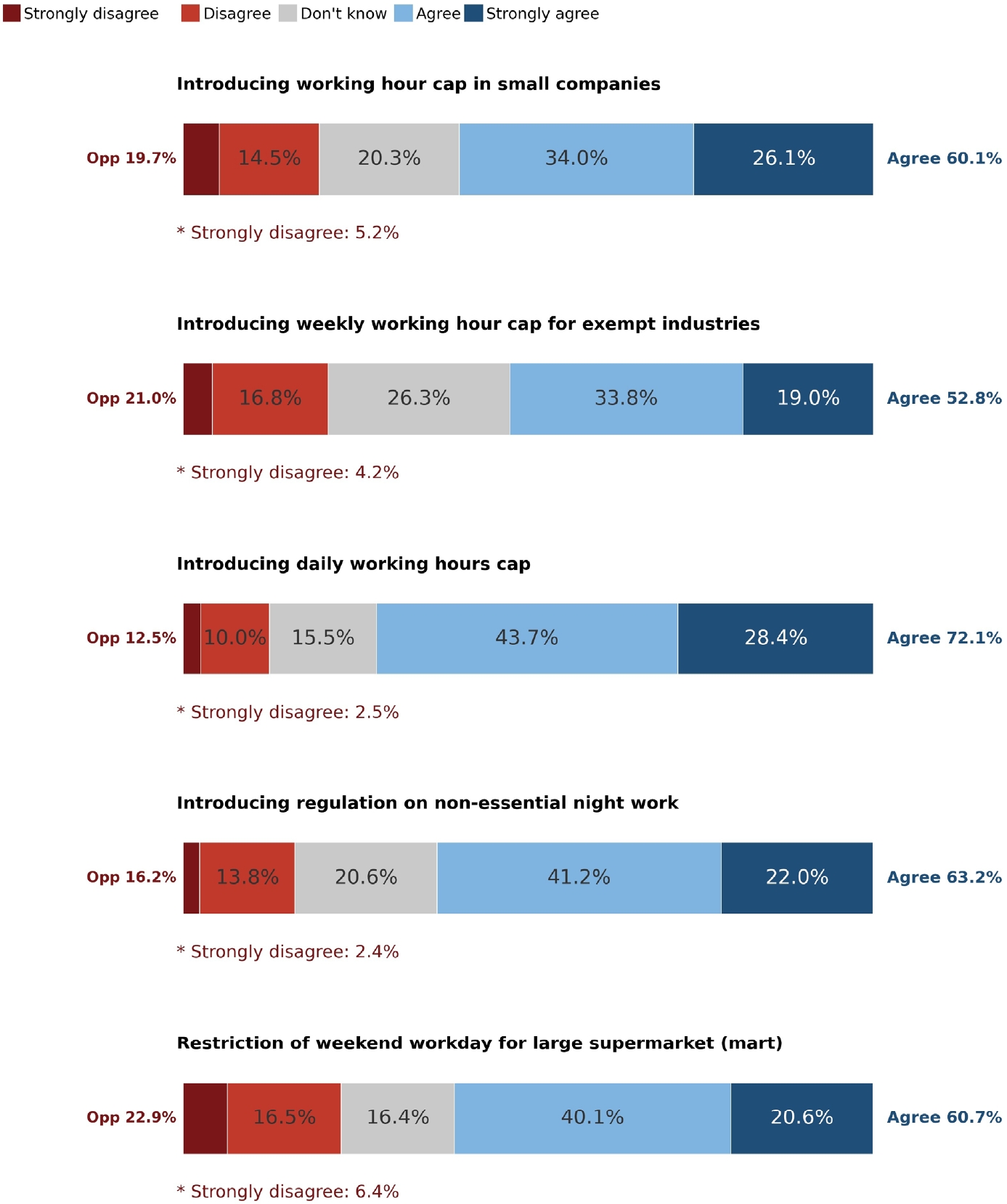
Opinions on working time regulatory measures among 5th KWSHS respondents (n = 5,783). Don't know responses are excluded from the percentage base for agree/disagree items. Dark blue: Strongly agree; Light blue: Agree; Gray: Don’t know; Light red: Disagree; Dark red: Strongly disagree.
Table 1.
Demographic and occupational characteristics of survey participants (n = 5,783)
| Male | Female | Total | |
|---|---|---|---|
| No. (%)a | 3,064 (53.0) | 2,719 (47.0) | 5,783 (100) |
| Age group (years) | |||
| 20–29 | 515 (16.8) | 507 (18.6) | 1,022 (17.7) |
| 30–39 | 561 (18.3) | 546 (20.1) | 1,107 (19.1) |
| 40–49 | 688 (22.5) | 666 (24.5) | 1,354 (23.4) |
| 50–59 | 726 (23.7) | 682 (25.1) | 1,408 (24.3) |
| ≥60 | 574 (18.7) | 318 (11.7) | 892 (15.4) |
| Occupation | |||
| Managerial/professional | 376 (12.3) | 317 (11.7) | 693 (12.0) |
| Office worker | 1,649 (53.8) | 1,875 (69.0) | 3,524 (60.9) |
| Service and sales | 337 (11.0) | 357 (13.1) | 694 (12.0) |
| Manual | 702 (22.9) | 170 (6.3) | 872 (15.1) |
| Educational level | |||
| High school or less | 441 (14.4) | 506 (18.6) | 947 (16.4) |
| College/university | 2,286 (74.6) | 1,979 (72.8) | 4,265 (73.8) |
| Graduate school or more | 337 (11.0) | 234 (8.6) | 571 (9.9) |
| Monthly income (quartile) | |||
| Lowest | 480 (15.7) | 1,045 (38.4) | 1,525 (26.4) |
| Low middle | 865 (28.2) | 943 (34.7) | 1,808 (31.3) |
| High middle | 832 (27.2) | 490 (18.0) | 1,322 (22.9) |
| Highest | 887 (28.9) | 241 (8.9) | 1,128 (19.5) |
| Employment type | |||
| Direct employment | 2,676 (87.3) | 2,437 (89.6) | 5,113 (88.7) |
| Indirect employment | 98 (3.2) | 74 (2.7) | 172 (3.0) |
| Self-employment | 290 (9.5) | 208 (7.6) | 498 (8.6) |
| Working hours type | |||
| Full-time | 2,914 (95.1) | 2,528 (93.0) | 5,442 (94.1) |
| Part-time | 150 (4.9) | 191 (7.0) | 341 (5.9) |
| Shift work | |||
| No | 2,736 (89.3) | 2,446 (90.0) | 5,182 (89.6) |
| Yes | 328 (10.7) | 273 (10.0) | 601 (10.4) |
Table 2.
Overall opinions on working time regulatory measures among 5th KWSHS respondents (n = 5,783)
- 1. Organisation for Economic Co-operation and Development. Hours Worked: Average Annual Hours Actually Worked. OECD Employment and Labour Market Statistics [database]. Paris, France: OECD Publishing; 2023.
- 2. Park J, Kim Y. Decrease in weekly working hours of Korean workers from 2010 to 2020 according to employment status and industrial sector. J Korean Med Sci 2023;38(22):e171.ArticlePubMedPMCPDF
- 3. Kim I, Min J. Working hours and the regulations in Korea. Ann Occup Environ Med 2023;35:e18.ArticlePubMedPMCPDF
- 4. Kim I. Changes in Korea's working time policy: the need for research on flexible working hours considering socioeconomic inequality. Ind Health 2024;62(2):77–8.
- 5. Pega F, Nafradi B, Momen NC, Ujita Y, Streicher KN, Pruss-Ustun AM, et al. Global, regional, and national burdens of ischemic heart disease and stroke attributable to exposure to long working hours for 194 countries, 2000-2016: a systematic analysis from the WHO/ILO Joint Estimates of the Work-related Burden of Disease and Injury. Environ Int 2021;154:106595.ArticlePubMedPMC
- 6. Kivimaki M, Jokela M, Nyberg ST, Singh-Manoux A, Fransson EI, Alfredsson L, et al. Long working hours and risk of coronary heart disease and stroke: a systematic review and meta-analysis of published and unpublished data for 603,838 individuals. Lancet 2015;386(10005):1739–46.ArticlePubMedPMC
- 7. Li J, Pega F, Ujita Y, Brisson C, Clays E, Descatha A, et al. The effect of exposure to long working hours on ischaemic heart disease: a systematic review and meta-analysis from the WHO/ILO Joint Estimates of the Work-related Burden of Disease and Injury. Environ Int 2020;142:105739.ArticlePubMedPMC
- 8. Descatha A, Sembajwe G, Pega F, Ujita Y, Baer M, Boccuni F, et al. The effect of exposure to long working hours on stroke: a systematic review and meta-analysis from the WHO/ILO Joint Estimates of the Work-related Burden of Disease and Injury. Environ Int 2020;142:105746.ArticlePubMed
- 9. Baek SU, Kim MS, Lim MH, Kim T, Won JU, Yoon JH. Working hours and the onset of suicidal ideation and depressive symptoms: a 10-year nationwide longitudinal study in South Korea (2012-2022). Psychiatry Res 2023;326:115344.ArticlePubMed
- 10. Park S, Kook H, Seok H, Lee JH, Lim D, Cho DH, et al. The negative impact of long working hours on mental health in young Korean workers. PLoS One 2020;15(8):e0236931.ArticlePubMedPMC
- 11. Lee HE, Rhie J. Impact of long working hours and shift work on unmet health care need among Korean workers. Saf Health Work 2022;13(1):17–22.ArticlePubMedPMC
- 12. Kim I, Koo MJ, Lee HE, Won YL, Song J. Overwork-related disorders and recent improvement of national policy in South Korea. J Occup Health 2019;61(4):288–96.ArticlePubMedPMCPDF
- 13. Dembe AE, Erickson JB, Delbos RG, Banks SM. The impact of overtime and long work hours on occupational injuries and illnesses: new evidence from the United States. Occup Environ Med 2005;62(9):588–97.ArticlePubMedPMC
- 14. Matre D, Skogstad M, Sterud T, Nordby KC, Knardahl S, Christensen JO, et al. Safety incidents associated with extended working hours: a systematic review and meta-analysis. Scand J Work Environ Health 2021;47(6):415–24.ArticlePubMedPMC
- 15. European Parliament, Council of the European Union. Directive 2003/88/EC of the European Parliament and of the Council of 4 November 2003, concerning certain aspects of the organization of working time. Off J Eur Union 2003;L299:9–19.
- 16. Su F, Huang D, Wang H, Yang Z. Associations of shift work and night work with risk of all-cause, cardiovascular and cancer mortality: a meta-analysis of cohort studies. Sleep Med 2021;86:90–8.ArticlePubMed
- 17. Kang HT, Kim CJ, Lee DW, Park SG, Lee J, Youn K, et al. Statement by the Korean Society of Occupational and Environmental Medicine on the proposed reform of working hours in South Korea. Ann Occup Environ Med 2023;35:e17.ArticlePubMedPMCPDF
- 18. Cho SS, Min J, Ko H, Kang MY. Data profile: Korean Work, Sleep, and Health Study (KWSHS). Ann Occup Environ Med 2025;37:e3.ArticlePubMedPMCPDF
- 19. International Labour Organization. C001: Hours of Work (Industry) Convention, 1919 (No. 1). Geneva, Switzerland: International Labour Organization; 1919.
- 20. Jang TW. Working hours and the regulations for night shift workers. Ann Occup Environ Med 2023;35:e19.ArticlePubMedPMCPDF
- 21. Jung-Choi K, Jang TW, Kang MY, Kim J, Kim EA. Special series I: working hours as a social determinant of workers' health. Ann Occup Environ Med 2023;35:e16.ArticlePubMedPMCPDF
- 22. Baek SU, Lee YM, Yoon JH. Association between long working hours and the development of suicidal ideation among female workers: an 8-year population-based study using the Korean Longitudinal Survey of Women & Family (2012-2020). Psychiatry Res 2024;333:115731.ArticlePubMed
- 23. Wu QJ, Sun H, Wen ZY, Zhang M, Wang HY, He XH, et al. Shift work and health outcomes: an umbrella review of systematic reviews and meta-analyses of epidemiological studies. J Clin Sleep Med 2022;18(2):653–62.ArticlePubMedPMC
- 24. Anxo D, Karlsson M. Overtime work: a review of literature and initial empirical analysis. Geneva, Switzerland: International Labour Organization; 2018 Conditions of Work and Employment Series No. 104. https://www.ilo.org/sites/default/files/wcmsp5/groups/public/%40ed_protect/%40protrav/%40travail/documents/publication/wcms_663072.pdf.. Updated 2019. Accessed March 3, 2026..
- 25. Korea Development Institute. Hours worked in the Korean growth story. https://www.kdi.re.kr/board/file/download?atch_no=fEfXBLYsm84JfXohqG%2FT7g%3D%3D&. Updated 2024. Accessed March 3, 2026..
- 26. Liu Y, Tanaka H; Fukuoka Heart Study Group. Overtime work, insufficient sleep, and risk of non-fatal acute myocardial infarction in Japanese men. Occup Environ Med 2002;59(7):447–51.ArticlePubMedPMC
- 27. Wong K, Chan AH, Ngan SC. The effect of long working hours and overtime on occupational health: a meta-analysis of evidence from 1998 to 2018. Int J Environ Res Public Health 2019;16(12):2102.ArticlePubMedPMC
REFERENCES
Figure & Data
REFERENCES
Citations
Citations to this article as recorded by 
 Cite
Cite XML Download
Workers' opinions on working time regulations: results from the 5th Korean Work, Sleep, and Health Study (KWSHS)
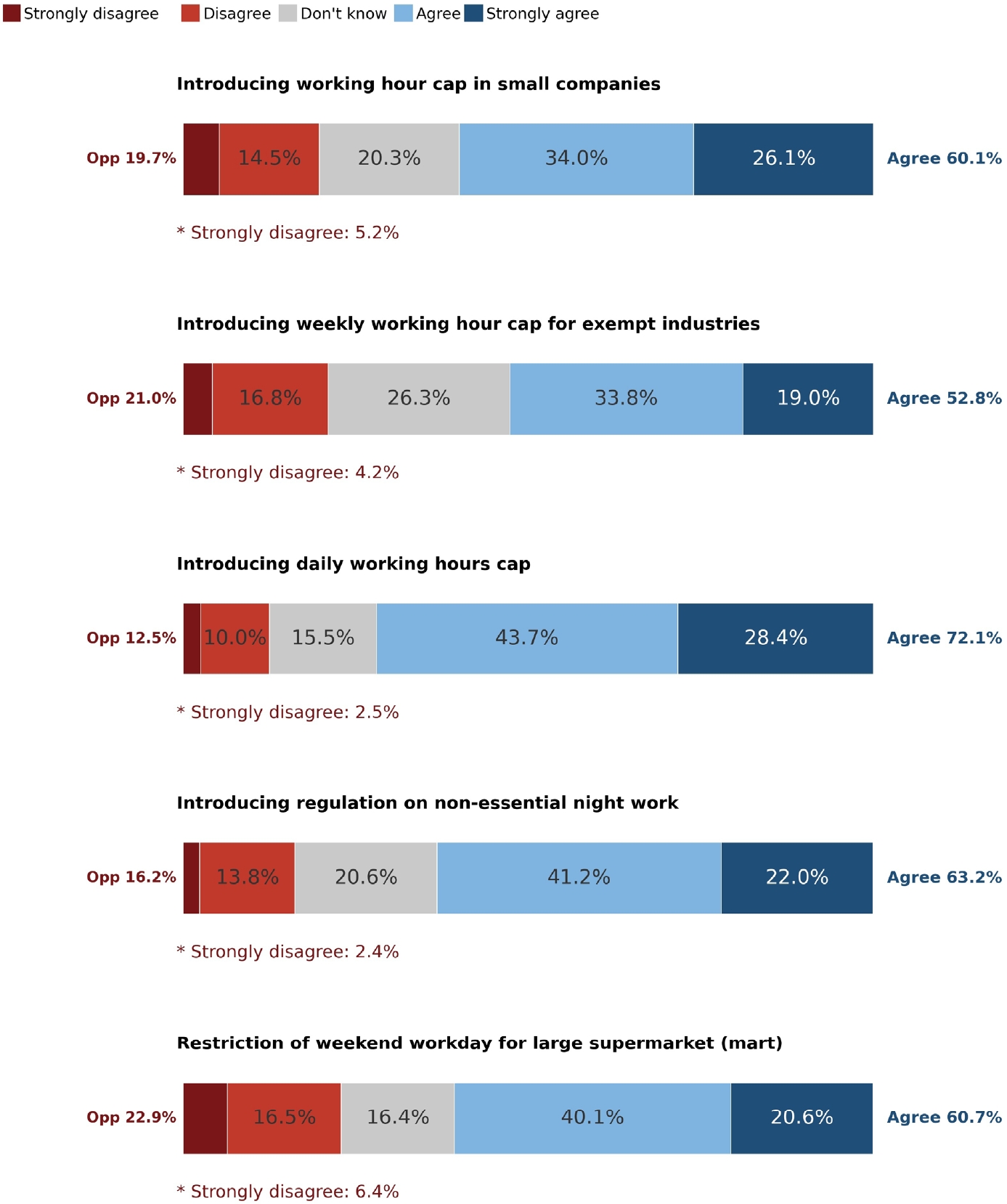
Fig. 1. Opinions on working time regulatory measures among 5th KWSHS respondents (n = 5,783). Don't know responses are excluded from the percentage base for agree/disagree items. Dark blue: Strongly agree; Light blue: Agree; Gray: Don’t know; Light red: Disagree; Dark red: Strongly disagree.
Fig. 1.
Workers' opinions on working time regulations: results from the 5th Korean Work, Sleep, and Health Study (KWSHS)
| Male | Female | Total | |
|---|---|---|---|
| No. (%) |
3,064 (53.0) | 2,719 (47.0) | 5,783 (100) |
| Age group (years) | |||
| 20–29 | 515 (16.8) | 507 (18.6) | 1,022 (17.7) |
| 30–39 | 561 (18.3) | 546 (20.1) | 1,107 (19.1) |
| 40–49 | 688 (22.5) | 666 (24.5) | 1,354 (23.4) |
| 50–59 | 726 (23.7) | 682 (25.1) | 1,408 (24.3) |
| ≥60 | 574 (18.7) | 318 (11.7) | 892 (15.4) |
| Occupation | |||
| Managerial/professional | 376 (12.3) | 317 (11.7) | 693 (12.0) |
| Office worker | 1,649 (53.8) | 1,875 (69.0) | 3,524 (60.9) |
| Service and sales | 337 (11.0) | 357 (13.1) | 694 (12.0) |
| Manual | 702 (22.9) | 170 (6.3) | 872 (15.1) |
| Educational level | |||
| High school or less | 441 (14.4) | 506 (18.6) | 947 (16.4) |
| College/university | 2,286 (74.6) | 1,979 (72.8) | 4,265 (73.8) |
| Graduate school or more | 337 (11.0) | 234 (8.6) | 571 (9.9) |
| Monthly income (quartile) | |||
| Lowest | 480 (15.7) | 1,045 (38.4) | 1,525 (26.4) |
| Low middle | 865 (28.2) | 943 (34.7) | 1,808 (31.3) |
| High middle | 832 (27.2) | 490 (18.0) | 1,322 (22.9) |
| Highest | 887 (28.9) | 241 (8.9) | 1,128 (19.5) |
| Employment type | |||
| Direct employment | 2,676 (87.3) | 2,437 (89.6) | 5,113 (88.7) |
| Indirect employment | 98 (3.2) | 74 (2.7) | 172 (3.0) |
| Self-employment | 290 (9.5) | 208 (7.6) | 498 (8.6) |
| Working hours type | |||
| Full-time | 2,914 (95.1) | 2,528 (93.0) | 5,442 (94.1) |
| Part-time | 150 (4.9) | 191 (7.0) | 341 (5.9) |
| Shift work | |||
| No | 2,736 (89.3) | 2,446 (90.0) | 5,182 (89.6) |
| Yes | 328 (10.7) | 273 (10.0) | 601 (10.4) |
| Item | No. (%) |
|---|---|
| Total | 5,783 (100) |
| Opinion on the current maximal weekly working hours | |
| Reducing the current working hour cap | 2,009 (34.7) |
| Extending the current working hour cap | 930 (16.1) |
| Maintaining the current working hour cap | 2,110 (36.5) |
| Don't know | 734 (12.7) |
| Introducing the working hour cap in small companies | |
| Strongly agree | 1,508 (26.1) |
| Agree | 1,965 (34.0) |
| Don't know | 1,176 (20.3) |
| Disagree | 836 (14.5) |
| Strongly disagree | 298 (5.2) |
| Introducing the weekly working hour cap for exempt industries | |
| Strongly agree | 1,096 (19.0) |
| Agree | 1,953 (33.8) |
| Don't know | 1,522 (26.3) |
| Disagree | 969 (16.8) |
| Strongly disagree | 243 (4.2) |
| Introducing the daily working hours cap | |
| Strongly agree | 1,641 (28.4) |
| Agree | 2,526 (43.7) |
| Don't know | 894 (15.5) |
| Disagree | 578 (10.0) |
| Strongly disagree | 144 (2.5) |
| Introducing regulation on non-essential night work | |
| Strongly agree | 1,274 (22.0) |
| Agree | 2,383 (41.2) |
| Don't know | 1,189 (20.6) |
| Disagree | 799 (13.8) |
| Strongly disagree | 138 (2.4) |
| Restriction of weekend workdays for large supermarkets | |
| Strongly agree | 1,191 (20.6) |
| Agree | 2,320 (40.1) |
| Don't know | 946 (16.4) |
| Disagree | 956 (16.5) |
| Strongly disagree | 370 (6.4) |
Table 1. Demographic and occupational characteristics of survey participants (n = 5,783)
Values are presented as number (%). Row percent.
Table 2. Overall opinions on working time regulatory measures among 5th KWSHS respondents (n = 5,783)
KWSHS: Korean Work, Sleep, and Health Study.


