 KSOEM
KSOEM

Articles
- Page Path
- HOME > Ann Occup Environ Med > Volume 38; 2026 > Article
- Original Article Korean occupational and environmental medicine specialists: demand-supply projections
-
Hee-Tae Kang1,*
 , Hye-Eun Lee2,3, Mo-Yeol Kang4, Chungwon Kang5, Kyong-sok Shin6, Hyeon-Taek Heo7, Yong Lim Won8, Jungwon Kim9
 -
Annals of Occupational and Environmental Medicine 2026;38:e34.
DOI: https://doi.org/10.35371/aoem.2026.38.e34
Published online: July 27, 2026
1Department of Occupational and Environmental Medicine, Wonju Severance Christian Hospital, Yonsei University Wonju College of Medicine, Wonju, Korea
2Department of Social and Preventive Medicine, Hallym University College of Medicine, Chuncheon, Korea
3Institute of Social Medicine, Hallym University College of Medicine, Chuncheon, Korea
4Department of Occupational and Environmental Medicine, Seoul St. Mary’s Hospital, College of Medicine, The Catholic University of Korea, Seoul, Korea
5Department of Occupational and Environmental Medicine, Hanil General Hospital, Seoul, Korea
6Sojunghan Industrial Health Institute Corp., Seoul, Korea
7Health Examination Bureau, Korean Industrial Health Association, Daejeon, Korea
8Quality Assurance and Analysis Department, Occupational Safety and Health Research Institute, Ulsan, Korea
9Department of Occupational and Environmental Medicine, Kosin University College of Medicine, Busan, Korea
- *Corresponding author: Hee-Tae Kang Department of Occupational and Environmental Medicine, Wonju Severance Christian Hospital, Yonsei University Wonju College of Medicine, 20 Ilsan‑ro, Wonju 26426, Korea E-mail: oemkang@yonsei.ac.kr, schizop2@naver.com
• Received: April 18, 2026 • Revised: July 16, 2026 • Accepted: July 16, 2026
© 2026 Korean Society of Occupational & Environmental Medicine
This is an Open Access article distributed under the terms of the Creative Commons Attribution Non-Commercial License (https://creativecommons.org/licenses/by-nc/4.0/) which permits unrestricted non-commercial use, distribution, and reproduction in any medium, provided the original work is properly cited.
- 369 Views
- 14 Download


Abstract
-
Background Korea has experienced changes in the balance between the demand for and supply of occupational and environmental medicine (OEM) specialists due to recent policy and environmental shifts. This study projected demand and supply for these specialists for 2025–2035, focusing on those working in special health examination institutions and occupational health management agencies.
-
Methods Demand was estimated by applying 2024 average workloads per OEM specialist to projected volumes of special health examinations and outsourced occupational health management for 2025–2035 under four scenarios that varied growth in outsourced management and the share of OEM specialists among participating physicians. Supply was projected using registration and official statistics for 1,010 specialists certified by 2025, combined with detailed residency cohort data, assumptions on future quotas, completion, and age at certification, and age-specific proportions working in the two institution types.
-
Results Average workloads in 2024 were 4,793 workers per OEM specialist for special health examinations and 9,193 workers per physician for outsourced occupational health management. The number of OEM specialists younger than 90 years is projected to increase from 968 in 2025 to 1,244 in 2035, with those working in the two institution types increasing from 697 to 910. Depending on the scenario, demand in 2035 ranges from 838 to 943 specialists, with supply exceeding demand in three scenarios but remaining 33 specialists short in the most expansionary scenario.
-
Conclusions Short‑term shortages of OEM specialists are likely but remain highly manageable, after which surplus capacity is expected. Policy efforts should therefore stabilize OEM residency pipelines and prepare institutional mechanisms to deploy surplus specialists beyond special health examinations and outsourced occupational health management.
BACKGROUND
Occupational and environmental medicine (OEM) in Korea began to develop alongside industrialization, with related systems, research, activities, and organizations being established over time. Following the 1988 mercury poisoning death of Moon Song‑myeon and the carbon disulfide poisoning incident at Wonjin Rayon factory, the Korean Society of Occupational Medicine was founded to train medical specialists to address occupational disease issues.1,2 Thereafter, the OEM specialty was officially established in Korea in 1996 to address work-related health risks, and has been maintained for 30 years as of 2026.3 In the initial phase, transitional provisions allowed specialists from other departments to obtain recognition as OEM specialists, and a total of 410 specialists acquired this qualification between 1996 and 2001. Specialists who completed the four‑year residency training program in OEM began to be produced in 2000. Annual production increased from about 10 to the low 30s over 2000–2015 and has since remained at that level. However, due to the medical‑political conflict surrounding the expansion of medical school admission quotas in Korea during 2024–2025, the number of new specialists in 2025 sharply decreased to 10. Consequently, the total number of OEM specialists produced up to 2025 reached 1,010.4
Chae et al.5 projected the demand for OEM specialists in Korea up to 2020, estimating needs for special health examination institutions and occupational health management agencies based on 2008 productivity. They forecasted no change in agency demand, while workers requiring special health examinations were expected to increase to 1,690,436. Kim et al.6 projected that 706–754 OEM specialists would be supplied by 2020.
Since 2014, institutional and environmental changes—including night shift health examinations,7 the Serious Accidents Punishment Act,8 and the 2024–2025 medical-political conflict9—have altered OEM specialist demand and supply. Therefore, this study updates projections for 2025–2035, focusing on personnel in special health examination institutions and occupational health management agencies.
METHODS
To project demand for OEM specialists, this study applied the methodology of Lee et al.,10 using administrative data from special health examinations and occupational health management agencies together with labor force projections.
To project the supply of OEM specialists, this study utilized registration data from the Korean Society of Occupational and Environmental Medicine and the Health and Welfare Statistical Yearbook of the Ministry of Health and Welfare to identify supply up to 2025. The expected supply from 2026 onward was estimated based on residency training and military service status as of September 2025. In addition, staffing data from the Ministry of Employment and Labor and the Korea Occupational Safety and Health Agency were analyzed to determine the distribution of specialists employed in special health examination institutions and occupational health management agencies.
Demand for OEM specialists was defined as demand arising in special health examination institutions and occupational health management agencies; we did not re‑estimate demand but used the projected service demand for these services from Lee et al.10 and converted it into required numbers of OEM specialists using 2024 workloads.
Demand for OEM specialists in special health examination institutions
The average number of special health examinations per OEM specialist was calculated by dividing the 2024 examinee population by the number of specialists working in special health examinations in 2025. The number of workers subject to special health examinations for 2025–2035 was projected by applying industry‑specific examination rates, estimated from 2017–2023 data, to sectoral employment projections. This average workload was then used to estimate, for each year from 2025 to 2035, the number of OEM specialists required, by dividing the projected number of workers subject to special health examinations by the average workload per specialist.
Demand for OEM specialists in occupational health management agencies
Demand for physicians in outsourced occupational health management was estimated by dividing the 2024 covered worker population by the 2025 number of physicians in occupational health management agencies to obtain the average number of workers managed per physician, and then dividing the projected covered population for 2025–2035 by this value. In this study, coverage was defined as the proportion of workers covered by outsourced occupational health management services among all employed workers, and the 2024 value of 8.5% was obtained by dividing the number of covered workers by the total number of employed workers. In scenarios 1 and 2, coverage was assumed to remain constant at 8.5%, whereas in scenarios 3 and 4, coverage was assumed to increase over time by extrapolating the annual growth rate observed between 2020 and 2024. Because the demand for outsourced occupational health management may change over time and physicians other than OEM specialists, including preventive medicine physicians, also participate in this work, demand for OEM specialists was projected under four scenarios: (1) constant coverage at 8.5% with a constant OEM share (one‑half); (2) constant coverage at 8.5% with the OEM share increasing from one‑half in 2025 to two‑thirds in 2035; (3) increasing coverage based on the 2020–2024 growth rate with a constant OEM share (one‑half); and (4) increasing coverage based on the 2020–2024 growth rate with the OEM share increasing from one‑half in 2025 to two‑thirds in 2035.
Total demand for OEM specialists
Total demand for OEM specialists from 2025 to 2035 was calculated by summing demand in special health examination institutions and demand in occupational health management agencies, and was projected under the same four scenarios applied to occupational health management agencies. In addition to the baseline projections based on the observed average workloads in 2024, we also calculated an alternative demand trajectory assuming increased workloads, with workers per OEM specialist rising from 4,793 to 5,000 in special health examinations and workers per physician rising from 9,193 to 10,000 in outsourced occupational health management.
Supply of OEM specialists was projected focusing on those expected to work in special health examination institutions and occupational health management agencies.
Projection of supply from existing OEM specialists
For the 1,010 OEM specialists certified by 2025, the age for each year from 2025 to 2035 was calculated from the date of birth. A discrepancy of 59 between the 2023 board‑certified count and the Health and Welfare Statistical Yearbook suggested unascertained deaths; however, because it was not possible to identify the individuals concerned, all certified specialists were assumed to be alive, and those aged 90 years or older were excluded on the assumption that they were no longer practicing.
Projection of supply from newly entering OEM specialists
To project the number of newly entering OEM specialists from 2026 onward, the following assumptions were made. As of September 2025, 20 fourth‑year, 30 third‑year, 28 second‑year, and 30 first‑year residents were in training; all second‑ to fourth‑year residents were assumed to complete training and become specialists, and 29 of the 30 first‑year residents were assumed to do so, allowing for possible withdrawal during residency. Residents who had resigned due to the medical‑political conflict but entered military service in 2025 (six fourth‑year, one third‑year, and three second‑year residents) were assumed to return to residency in 2028, complete training, and qualify as specialists. In 2026, when the residency quota was reduced to 33, 32 new specialists were assumed, allowing for mid‑training withdrawal, and in 2027, when the quota was restored to 35, 33 new specialists were assumed on the same basis. From 2028 onward, the quota was assumed to remain at 35, and the annual number of new specialists was set to the average for the most recent 10‑year period without medical‑political conflict (2015–2024), with 33 specialists in 2032, 33 in 2033, 34 in 2034, and 33 in 2035.
To project the age distribution of newly entering OEM specialists, the age structure at board certification observed among those qualifying between 2015 and 2024 was assumed to remain unchanged thereafter (Supplementary Table 1).
Annual and age‑specific supply was projected by combining existing OEM specialists up to 2025 with newly produced specialists from 2026 onward. The projected number working in special health examination institutions or occupational health management agencies each year was then obtained by applying the 2025 age‑specific proportions employed in these settings (Supplementary Table 2), and the resulting counts were converted to integers while keeping their sum consistent with the total projected number of specialists.
This study used secondary administrative data that were fully anonymized. According to relevant regulations, institutional review board (IRB) approval and informed consent were not required.
RESULTS
Dividing the 2,765,337 workers who underwent special health examinations in 2024 by the 577 OEM specialists working in this field in 2025 yielded an average workload of 4,793 workers per specialist. The 2,436,163 workers under outsourced occupational health management in 2024 divided by the 265 physicians in occupational health management agencies in 2025 yielded an average workload of 9,193 workers per physician.
Projected demand for OEM specialists was as follows. Under scenario 1 (constant coverage at the 2024 level of 8.5% and a constant OEM share of one‑half), demand rises from 702 specialists in 2025 to 838 in 2035. Under scenario 2 (constant coverage with the OEM share increasing from one‑half in 2025 to two‑thirds in 2035), demand rises from 702 to 882. Under scenario 3 (increasing coverage with the OEM share fixed at one‑half), demand rises from 705 to 883, and under scenario 4 (increasing coverage with the OEM share rising from one‑half to two‑thirds), demand rises from 705 to 943 (Table 1).
Among existing OEM specialists younger than 90 years, the number decreases from 968 in 2025 to 929 in 2035 (Supplementary Table 3). The cumulative number of newly produced specialists from 2026 onward is projected to reach 315 by 2035 (Supplementary Table 4). Consequently, the total number of OEM specialists younger than 90 years increases from 968 in 2025 to 1,244 in 2035, an increase of 276 (Table 2), and the number working in special health examination institutions or occupational health management agencies increases from 697 in 2025 to 910 in 2035, an increase of 213 (Table 3).
In all scenarios, supply is lower than demand in 2025. In scenarios 1–3, supply subsequently grows faster than demand, exceeding demand in 2028 under scenario 1 and in 2031 under scenarios 2 and 3. In contrast, under scenario 4, shortages persist throughout 2025–2035, with a deficit of 33 OEM specialists in 2035. However, this shortage is eliminated if workload increases such that workers per OEM specialist in special health examinations rise from 4,793 to 5,000 and workers per physician in outsourced occupational health management rise from 9,193 to 10,000, in which case supply exceeds demand from 2025 onward and remains in surplus through 2035 (Fig. 1, Supplementary Table 5).
DISCUSSION
This study projected the demand and supply of OEM specialists. Across most scenarios, demand initially exceeds supply but later reverses, whereas in the scenario with both rising outsourced occupational health management demand and an increasing OEM share, shortages persist through 2035. This scenario represents an upper-bound demand trajectory rather than a central forecast. Even under this assumption, the shortage can be mitigated by a moderate increase in workload per OEM specialist. Such increases should be understood as a temporary buffer achieved through productivity gains or limited flexibility in staffing standards, not as structural workforce reductions that would permanently shift demand.
Although this study projected demand and supply for OEM specialists, substantial uncertainty remains. In the United States, for example, government agencies have repeatedly projected large OEM specialist shortages since the 1970s, yet these forecasts have often diverged markedly from actual hiring demand in industry.11 In Korea, earlier studies projected no further increase in outsourced occupational health management,5 yet the number of covered workers rose from 1,408,010 in 2010 to 2,436,163 in 2024. Likewise, the projected number of workers receiving special health examinations in 2020 was 1,690,436, whereas the actual figure reached 2,212,769.12 The number of OEM specialists in 2020 also exceeded prior projections, reaching 814.1 These discrepancies appear to be largely driven by policy changes, including the introduction of night shift health examinations and the Serious Accidents Punishment Act. Accordingly, the estimates in this study should be interpreted as scenario-based ranges rather than precise forecasts, particularly over the longer term.
Demand for OEM specialists may increase with expansion of the eligible population or scope of special health examinations,13 an increase in the number of special health examination institutions, and expansion of the roles of OEM specialists.2,14 Conversely, demand may decrease with efficiency gains from tools such as artificial intelligence15,16 or organizational practices that intentionally limit staffing, as well as a shift toward single consultant models in occupational health management.
Additional uncertainty arises from structural factors. The supply of preventive medicine specialists eligible to work in occupational health management agencies may change; shifts in industrial structure may alter the composition of workers requiring special health examinations (e.g., fewer manufacturing workers exposed to chemical and physical hazards but more health care workers subject to night‑work examinations);3,5 overall employment may decline due to population aging yet be offset by increased labor force participation among older adults or inflows of foreign workers;17 and policy or legal changes by the Ministry of Employment and Labor may increase or decrease demand for OEM specialists.
Supply may increase with expansion of OEM residency quotas. Conversely, supply may decrease if temporary shortages are addressed by loosening physician staffing regulations, potentially worsening employment conditions and discouraging residency applications, as observed in the United States.11 Additional factors include early retirement, movement into other fields, disruptions such as the 2024–2025 medical-political conflict, and reduced training capacity due to financial constraints.3,11,18,19 Finally, uncertainty remains because the age distribution at board certification was assumed to remain constant, although it may vary over time.
If the current environment for supplying OEM specialists remains unchanged, the number of specialists is projected to keep increasing through 2045, even beyond 2036 (Supplementary Table 6). Although demand after 2036 cannot be reliably projected, workloads related to special health examinations and outsourced occupational health management are unlikely to grow without limit. Thus, even in scenarios where demand continues to rise, modest shortages in the near term are likely to be manageable through workload adjustments, after which surplus specialists could be redeployed to other roles. These projections are based on the current reimbursement structure for special health examinations and related services and therefore reflect demand under existing financial constraints. If future reforms lead to higher fees that better reflect the costs of professional expertise and in-depth follow-up management, medical institutions may be able to expand the roles of OEM specialists and reduce caseloads per physician, revealing a higher level of realized demand than that estimated in this study.
Although many OEM specialists currently work in special health examination institutions for economic reasons, the professional domain of OEM specialists extends far beyond these settings.18 They can contribute to a wide range of activities, including on-site occupational physician services, work-relatedness and fitness for work assessments, operation and support of Workers’ Health Centers, return-to-work programs, involvement in sickness benefit schemes, management of work related musculoskeletal and mental disorders, workplace health promotion, and advisory roles at organizational and policy levels.11,20 In this study, however, demand was quantified only for services provided through special health examinations and outsourced occupational health management, so the additional workforce required to systematically implement these broader roles was not captured in the projection model. As the supply of OEM specialists is projected to eventually exceed the demand defined in this way, these broader occupational health roles will become increasingly important as potential areas of deployment and could substantially reduce any apparent surplus if they are fully integrated into routine practice. In this context, the re-establishment or strengthening of occupational physician posts in workplaces, which had been constrained by the exemption introduced under the Special Act on Deregulation of Corporate Activities, may serve as one example of how OEM specialists could be integrated into workplace-based preventive services. Because such changes in the demand-supply structure are unlikely to occur abruptly, it is important to closely monitor trends and gradually develop institutional frameworks that enable OEM specialists to expand stepwise into occupational physician positions and other diverse occupational health roles.
To expand the roles of OEM specialists, a stable supply of specialists is a prerequisite. Given the various demand‑ and supply‑side factors discussed above, attention must be paid to the possibility that the number of residents in OEM training programs may decrease. In particular, when the Ministry of Employment and Labor formulates system and workforce policies, it should carefully consider how these policies will influence OEM specialist demand and supply; otherwise, policies may inadvertently reduce supply or draw newly trained specialists into specific sectors in a “black‑hole” manner, misaligning workforce training with actual industrial demand and adversely affecting both the supply and utilization of specialists, as has already occurred in the United States.11,19
To prevent this, it is first necessary for the Ministry of Employment and Labor to systematically collect and analyze data on the demand and supply of OEM specialists. At present, workforce data are scattered across ministry headquarters, the Korea Occupational Safety and Health Agency, and regional and district labor offices, and in some cases are not collected at all; even when collected, they are often poorly managed and subject to coding errors, limiting their usefulness for understanding actual demand and supply. Establishing a centralized system at ministry headquarters for systematic workforce data collection will therefore be essential, and these data should be used to regularly project the demand and supply of OEM specialists.21
This study has several limitations. First, this study projected demand and supply only for OEM specialists working in special health examination institutions and occupational health management agencies, excluding those employed in research, public institutions, and as occupational physicians because relevant data were unavailable and future demand in these areas is highly uncertain. Nevertheless, by applying the current proportion of OEM specialists working in special health examination institutions or occupational health management agencies based on the best available workforce data, the projections for this sector are reasonably robust. Second, the analysis assumed that the proportion of OEM specialists working in special health examination institutions or occupational health management agencies would remain constant through 2035, even though it would likely increase when demand exceeds supply and decrease when supply exceeds demand; given that supply is projected to surpass demand, this proportion is expected to fall in the long term. Third, deaths among OEM specialists could not be identified and thus were not directly reflected in the analysis; although the discrepancy between the number of board‑certified specialists and the number reported in the Health and Welfare Statistical Yearbook suggests unobserved mortality, individuals aged 90 years or older were excluded and age‑specific work participation rates were applied to reduce distortion of the projections. Fourth, because performance data for special health examinations and outsourced occupational health management were from 2024 and workforce data from 2025, the average workload per specialist may have been underestimated, leading to slightly higher projected demand. Fifth, our projections are grounded in the current average workload per specialist and do not quantitatively incorporate hypothetical quality-driven in caseloads, which would require substantial changes in reimbursement and service organization and are difficult to model with existing data.
Nonetheless, this study is meaningful in that it provides a reasonably grounded medium‑ to long‑term projection of demand and supply for OEM specialists using currently available data. The results suggest that, if short‑term shortages are managed through workload adjustments, supply will eventually exceed demand, enabling OEM specialists to be deployed to other tasks. These findings are expected to serve as a basic reference in future efforts to reform occupational health policy and redefine the roles of OEM specialists.
CONCLUSIONS
From 2025 to 2035, the number of OEM specialists in Korea is projected to increase, and in most scenarios this growth outpaces the increase in demand arising from special health examinations and outsourced occupational health management. In three of the four demand scenarios, the initial short-term shortage of specialists reverses to a surplus by 2028 or 2031, whereas in the most expansionary scenario a modest shortage of 33 specialists persists in 2035 but can be eliminated by a small increase in workload per specialist. These findings indicate that, while short-term supply shortages are likely, they are quantitatively manageable, and in the medium to long term the supply of specialists is expected to be sufficient or excessive for demand in the two focal institutional settings. Accordingly, policies should focus both on stabilizing the training pipeline for OEM specialists and on preparing institutional mechanisms to utilize surplus specialists in areas beyond special health examinations and outsourced occupational health management, in line with the expanded roles anticipated for this workforce.
Abbreviation
-
Funding
This research was supported by the Occupational Safety and Health Research Institute (2025-OSHRI-1923) and the Korean Society of Occupational and Environmental Medicine, funded by the Korea Occupational Safety and Health Agency.
-
Competing interests
Mo-Yeol Kang and Jungwon Kim, contributing editors of the Annals of Occupational and Environmental Medicine, were not involved in the editorial evaluation or decision to publish this article. All remaining authors have declared no conflicts of interest.
-
Author contributions
Conceptualization: Kang HT, Lee HE, Kim J. Data curation: Kang HT, Lee HE, Kang C, Shin KS, Heo HT, Won YL. Methodology/formal analysis/validation: Kang HT, Lee HE, Kang MY. Project administration: Lee HE, Won YL, Kim J. Funding acquisition: Kim J. Writing - original draft: Kang HT. Writing - review & editing: Kang HT, Lee HE, Kang MY, Kang C, Shin KS, Heo HT, Won YL, Kim J.
NOTES
SUPPLEMENTARY MATERIAL
Supplementary Table 1.
Age at qualification as an occupational and environmental medicine specialist (2015–2024).
Supplementary Table 2.
Proportion of specialists working in special health examination institutions and occupational health management agencies by age group.
Supplementary Table 3.
Projected annual number of existing occupational and environmental medicine specialists by age group.
Supplementary Table 4.
Projected annual number of newly qualified occupational and environmental medicine specialists by age group from 2026 onward.
Supplementary Table 5.
Projected demand and supply of occupational and environmental medicine specialists (number of specialists).
Supplementary Table 6.
Projected annual number of occupational and environmental medicine specialists by age group.
Fig. 1.
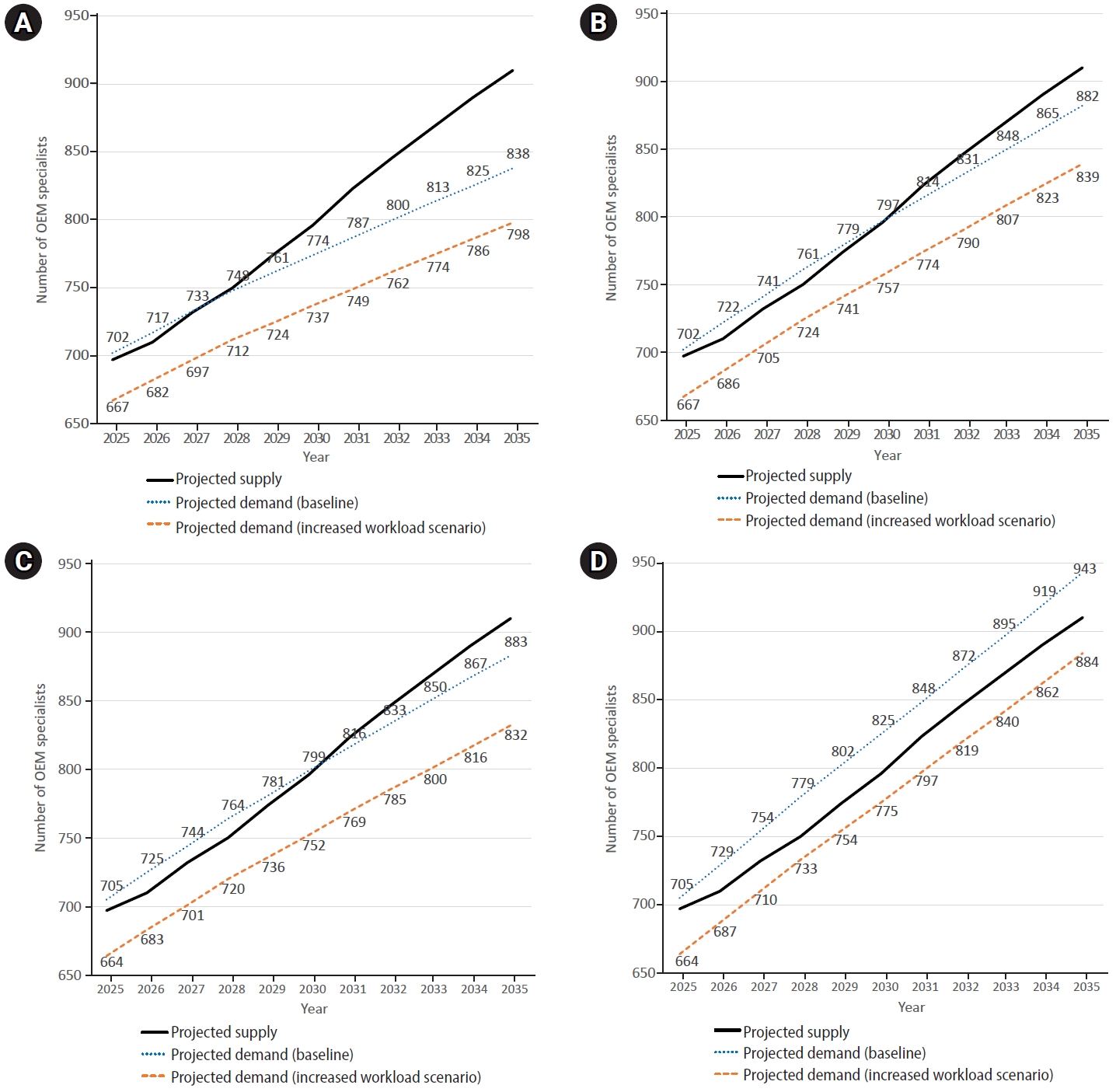
Projected demand and supply of occupational and environmental medicine (OEM) specialists in Korea from 2025 to 2035 under four scenarios. Projected supply, projected demand, and projected demand assuming increased workload (with raised limits of either 5,000 special health examinations or 10,000 outsourced workers per specialist; not both) are shown for each year. (A) Scenario 1: The proportion of workers covered by outsourced occupational health management services relative to total employment is held constant at the 2024 level, and the proportion of occupational and environmental medicine specialists among physicians in occupational health management agencies remains constant at one‑half. (B) Scenario 2: The proportion of workers covered by outsourced occupational health management services relative to total employment is held constant at the 2024 level, while the proportion of occupational and environmental medicine specialists among physicians in occupational health management agencies gradually increases from one‑half in 2025 to two‑thirds in 2035. (C) Scenario 3: The proportion of workers covered by outsourced occupational health management services relative to total employment increases over time, following the upward trend observed during 2020–2024, while the proportion of occupational and environmental medicine specialists among physicians in occupational health management agencies remains constant at one‑half. (D) Scenario 4: Both the proportion of workers covered by outsourced occupational health management services relative to total employment and the proportion of occupational and environmental medicine specialists among physicians in occupational health management agencies increase over time, with the latter rising gradually from one‑half in 2025 to two‑thirds in 2035.
Table 1.
Projected number of demand for occupational and environmental medicine specialists
| Year | Scenario 1a | Scenario 2b | Scenario 3c | Scenario 4d |
|---|---|---|---|---|
| 2025 | 702 | 702 | 705 | 705 |
| 2026 | 717 | 722 | 725 | 729 |
| 2027 | 733 | 741 | 744 | 754 |
| 2028 | 748 | 761 | 764 | 779 |
| 2029 | 761 | 779 | 781 | 802 |
| 2030 | 774 | 797 | 799 | 825 |
| 2031 | 787 | 814 | 816 | 848 |
| 2032 | 800 | 831 | 833 | 872 |
| 2033 | 813 | 848 | 850 | 895 |
| 2034 | 825 | 865 | 867 | 919 |
| 2035 | 838 | 882 | 883 | 943 |
aScenario 1 (the proportion of workers covered by outsourced occupational health management services is held constant, and the proportion of occupational and environmental medicine specialists among physicians in health management agencies is also held constant);
bScenario 2 (the proportion of workers covered by outsourced occupational health management services is held constant, while the proportion of occupational and environmental medicine specialists among physicians in health management agencies gradually increases from one‑half to two‑thirds);
cScenario 3 (the proportion of workers covered by outsourced occupational health management services increases, while the proportion of occupational and environmental medicine specialists among physicians in health management agencies is held constant);
dScenario 4 (the proportion of workers covered by outsourced occupational health management services increases, while the proportion of occupational and environmental medicine specialists among physicians in health management agencies gradually increases from one‑half to two‑thirds)
Table 2.
Projected annual number of occupational and environmental medicine specialists by age group
Table 3.
Projected annual number of occupational and environmental medicine specialists by age group working in special health examination institutions or occupational health management agencies
- 1. The Korean Society of Occupational and Environmental Medicine. https://ksoem.or.kr. Updated 2026. Accessed March 10, 2026.
- 2. Kim T. The publicness of occupational and environmental medicine should be expanded. Public Health Affairs 2019;3(1):171–5.ArticlePDF
- 3. Baker B, Kesler D, Guidotti T. Occupational and environmental medicine: public health and medicine in the workplace. Am J Public Health 2020;110(5):636–7.ArticlePubMedPMC
- 4. Ministry of Health and Welfare. Health and Welfare Statistical Yearbook 2024. Sejong, Korea: Ministry of Health and Welfare; 2024.
- 5. Chae Y, Kim J, Leem J. Estimation of demand and supply for occupational and environmental medicine specialties in Korea (II): demand estimation and demand-supply balance. Korean J Occup Environ Med 2011;23(1):80–8.ArticlePDF
- 6. Kim J, Chae Y, Leem J. Estimation of demand and supply for occupational and environmental medicine specialties in Korea (I): estimation of supply. Korean J Occup Environ Med 2011;23(1):71–9.ArticlePDF
- 7. Ministry of Employment and Labor. Guidance on Major Revisions to Special Health Examinations for Night Work: Q&A and Guidelines. https://www.moel.go.kr/news/notice/noticeView.do?bbs_seq=1389170242858. Updated 2014. Accessed March 10, 2026.
- 8. Park NK, Chae JG. A study on the current status of safety management and improvement measures following the enforcement "Serious Accidents Punishment Act". J Soc Disaster Inf 2024;20(3):533–40.
- 9. Cheong Y. The 2024 medical-political conflict and the future of Korean healthcare. Korean J Med Ethics 2025;28(1):93–101.ArticlePDF
- 10. Lee HE, Kang HT, Kang MY, Kang C, Shin KS, Heo HT, et al. Current status and demand projections for occupational and environmental medicine specialists: focus on special health examinations and outsourced occupational health management services. Ann Occup Environ Med 2026;38:e23.Article
- 11. LaDou J. The rise and fall of occupational medicine in the United States. Am J Prev Med 2002;22(4):285–95.ArticlePubMed
- 12. Ministry of Employment and Labor. Results of workers' health examinations in 2020. https://www.moel.go.kr/info/publicdata/majorpublish/majorPublishView.do?bbs_seq=20211202056. Updated 2021. Accessed March 10, 2026.
- 13. Son MJ. A legal study on introduction of psychiatric part in worker medical examination Ⅱ: implications for Article 26-2 Occupational Safety and Health Act “Preventive measures against health hazards caused by verbal abuse by customers”. Dong-A Law Rev 2019;85:223–48.Article
- 14. Kim Y, Kim I. Medical certification in sickness benefit scheme (II): practical approaches for evaluating work disability. Ann Occup Environ Med 2025;37:e24.ArticlePubMedPMCPDF
- 15. Lim JY, Kim KH, Mun SK. How does medical artificial intelligence revolutionize physician productivity? Yonsei Med J 2026;67(1):1–8.ArticlePubMedPMCPDF
- 16. Almyranti M, Sutherland E, Ash N, Eiszele S. Artificial Intelligence and the Health Workforce: Perspectives from Medical Associations on AI in Health. OECD Artificial Intelligence Papers, No. 28. Paris, France: OECD Publishing; 2024.
- 17. Han J, Kim D, Kim M, Lee J. Study on the Efficient Utilization of Human Resources in the Era of Population Decline. Sejong, Korea: Korea Development Institute (KDI); 2024.
- 18. Green-McKenzie J, Khan A, Redlich CA, Margarin AR, McKinney ZJ. The future of occupational and environmental medicine. J Occup Environ Med 2022;64(12):e857–63.ArticlePubMed
- 19. Martin CJ. The slow-moving crisis of training in occupational and environmental medicine. J Occup Environ Med 2024;66(10):e528–36.ArticlePubMed
- 20. Kim JS, Kim DS, Gil HJ, Park YS, Sin HH, Park JT. Significance and prospect of workers health center. J Korean Med Assoc 2014;57(2):159–66.Article
- 21. Zhang Y, Callaghan-Koru JA, Koru G. The challenges and opportunities of continuous data quality improvement for healthcare administration data. JAMIA Open 2024;7(3):ooae058.ArticlePubMedPMCPDF
REFERENCES
Figure & Data
REFERENCES
Citations
Citations to this article as recorded by 
 Cite
Cite XML Download
Korean occupational and environmental medicine specialists: demand-supply projections
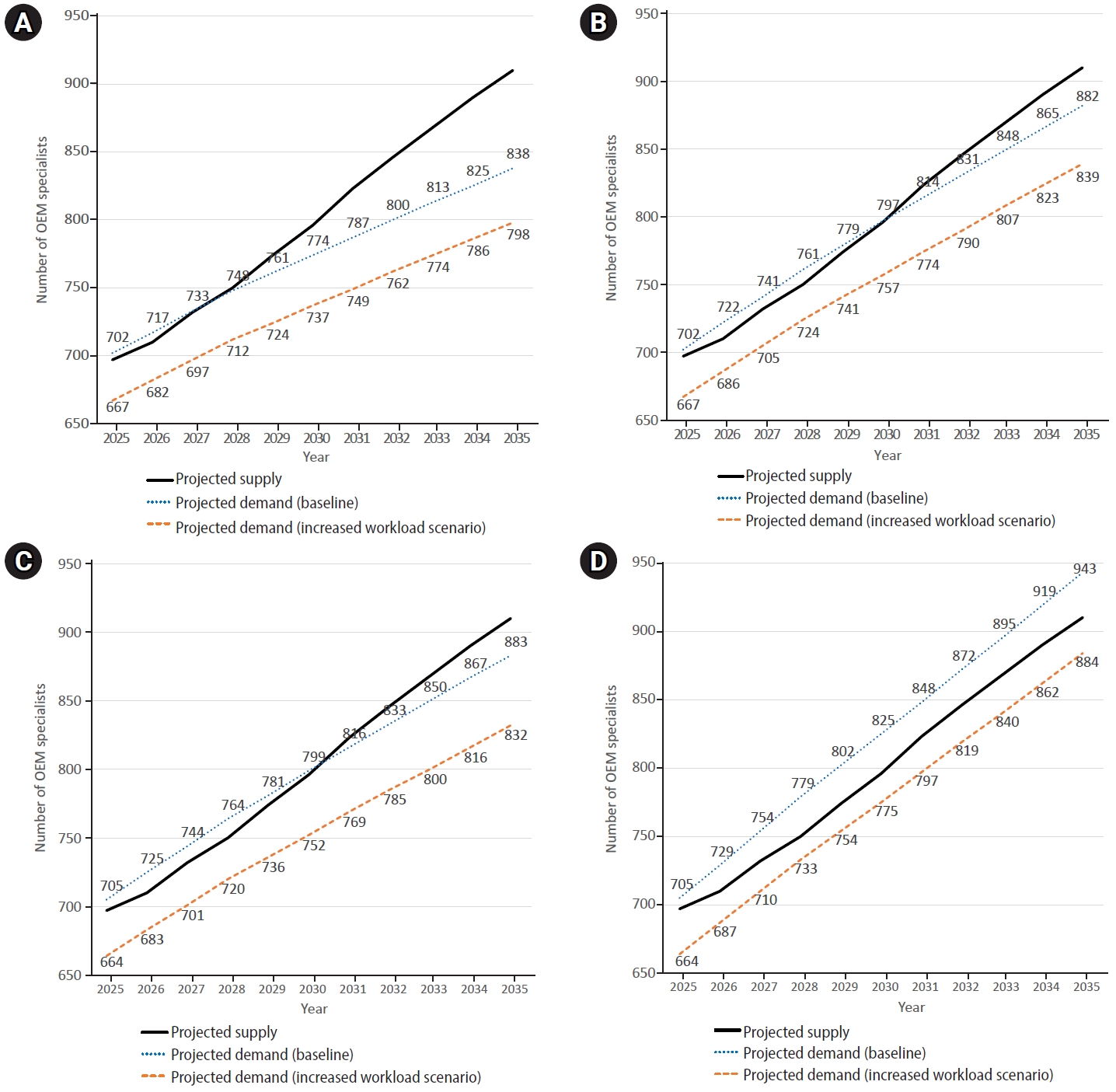
Fig. 1. Projected demand and supply of occupational and environmental medicine (OEM) specialists in Korea from 2025 to 2035 under four scenarios. Projected supply, projected demand, and projected demand assuming increased workload (with raised limits of either 5,000 special health examinations or 10,000 outsourced workers per specialist; not both) are shown for each year. (A) Scenario 1: The proportion of workers covered by outsourced occupational health management services relative to total employment is held constant at the 2024 level, and the proportion of occupational and environmental medicine specialists among physicians in occupational health management agencies remains constant at one‑half. (B) Scenario 2: The proportion of workers covered by outsourced occupational health management services relative to total employment is held constant at the 2024 level, while the proportion of occupational and environmental medicine specialists among physicians in occupational health management agencies gradually increases from one‑half in 2025 to two‑thirds in 2035. (C) Scenario 3: The proportion of workers covered by outsourced occupational health management services relative to total employment increases over time, following the upward trend observed during 2020–2024, while the proportion of occupational and environmental medicine specialists among physicians in occupational health management agencies remains constant at one‑half. (D) Scenario 4: Both the proportion of workers covered by outsourced occupational health management services relative to total employment and the proportion of occupational and environmental medicine specialists among physicians in occupational health management agencies increase over time, with the latter rising gradually from one‑half in 2025 to two‑thirds in 2035.
Fig. 1.
Korean occupational and environmental medicine specialists: demand-supply projections
| Year | Scenario 1 |
Scenario 2 |
Scenario 3 |
Scenario 4 |
|---|---|---|---|---|
| 2025 | 702 | 702 | 705 | 705 |
| 2026 | 717 | 722 | 725 | 729 |
| 2027 | 733 | 741 | 744 | 754 |
| 2028 | 748 | 761 | 764 | 779 |
| 2029 | 761 | 779 | 781 | 802 |
| 2030 | 774 | 797 | 799 | 825 |
| 2031 | 787 | 814 | 816 | 848 |
| 2032 | 800 | 831 | 833 | 872 |
| 2033 | 813 | 848 | 850 | 895 |
| 2034 | 825 | 865 | 867 | 919 |
| 2035 | 838 | 882 | 883 | 943 |
| Year | Age (years) | Total | |||||||||||
|---|---|---|---|---|---|---|---|---|---|---|---|---|---|
| ≤34 | 35–39 | 40–44 | 45–49 | 50–54 | 55–59 | 60–64 | 65–69 | 70–74 | 75–79 | 80–84 | 85–89 | ||
| 2025 | 71 | 122 | 148 | 144 | 74 | 116 | 134 | 70 | 27 | 23 | 16 | 23 | 968 |
| 2026 | 60 | 132 | 141 | 153 | 78 | 97 | 141 | 86 | 34 | 24 | 18 | 20 | 984 |
| 2027 | 54 | 133 | 142 | 163 | 89 | 93 | 140 | 91 | 45 | 20 | 19 | 19 | 1,008 |
| 2028 | 61 | 120 | 145 | 159 | 108 | 82 | 134 | 110 | 53 | 22 | 20 | 20 | 1,034 |
| 2029 | 61 | 136 | 138 | 157 | 120 | 80 | 127 | 118 | 66 | 22 | 20 | 16 | 1,061 |
| 2030 | 63 | 134 | 140 | 150 | 144 | 74 | 116 | 134 | 70 | 27 | 23 | 16 | 1,091 |
| 2031 | 69 | 129 | 153 | 143 | 153 | 78 | 97 | 141 | 86 | 34 | 24 | 18 | 1,125 |
| 2032 | 72 | 123 | 154 | 145 | 163 | 89 | 93 | 140 | 91 | 45 | 20 | 19 | 1,154 |
| 2033 | 72 | 133 | 143 | 148 | 159 | 108 | 82 | 134 | 110 | 53 | 22 | 20 | 1,184 |
| 2034 | 73 | 130 | 159 | 141 | 157 | 120 | 80 | 127 | 118 | 66 | 22 | 20 | 1,213 |
| 2035 | 72 | 134 | 157 | 143 | 150 | 144 | 74 | 116 | 134 | 70 | 27 | 23 | 1,244 |
| Year | Age (years) | Total | |||||||||||
|---|---|---|---|---|---|---|---|---|---|---|---|---|---|
| ≤34 | 35–39 | 40–44 | 45–49 | 50–54 | 55–59 | 60–64 | 65–69 | 70–74 | 75–79 | 80–84 | 85–89 | ||
| 2025 | 49 | 103 | 133 | 124 | 58 | 70 | 72 | 41 | 23 | 15 | 3 | 6 | 697 |
| 2026 | 41 | 111 | 127 | 132 | 61 | 59 | 76 | 50 | 29 | 16 | 3 | 5 | 710 |
| 2027 | 37 | 112 | 128 | 141 | 70 | 56 | 75 | 53 | 38 | 13 | 4 | 5 | 732 |
| 2028 | 42 | 101 | 130 | 137 | 85 | 50 | 72 | 65 | 45 | 14 | 4 | 5 | 750 |
| 2029 | 42 | 115 | 124 | 135 | 94 | 48 | 68 | 69 | 56 | 15 | 4 | 4 | 774 |
| 2030 | 43 | 113 | 126 | 129 | 113 | 45 | 62 | 79 | 60 | 18 | 4 | 4 | 796 |
| 2031 | 48 | 109 | 137 | 123 | 120 | 47 | 52 | 83 | 73 | 22 | 4 | 5 | 823 |
| 2032 | 50 | 104 | 138 | 125 | 128 | 54 | 50 | 82 | 77 | 29 | 4 | 5 | 846 |
| 2033 | 50 | 112 | 129 | 127 | 125 | 65 | 44 | 78 | 94 | 35 | 4 | 5 | 868 |
| 2034 | 50 | 110 | 143 | 122 | 123 | 72 | 43 | 74 | 101 | 43 | 4 | 5 | 890 |
| 2035 | 50 | 113 | 141 | 123 | 117 | 87 | 40 | 68 | 114 | 46 | 5 | 6 | 910 |
Table 1. Projected number of demand for occupational and environmental medicine specialists
Scenario 1 (the proportion of workers covered by outsourced occupational health management services is held constant, and the proportion of occupational and environmental medicine specialists among physicians in health management agencies is also held constant); Scenario 2 (the proportion of workers covered by outsourced occupational health management services is held constant, while the proportion of occupational and environmental medicine specialists among physicians in health management agencies gradually increases from one‑half to two‑thirds); Scenario 3 (the proportion of workers covered by outsourced occupational health management services increases, while the proportion of occupational and environmental medicine specialists among physicians in health management agencies is held constant); Scenario 4 (the proportion of workers covered by outsourced occupational health management services increases, while the proportion of occupational and environmental medicine specialists among physicians in health management agencies gradually increases from one‑half to two‑thirds)
Table 2. Projected annual number of occupational and environmental medicine specialists by age group
Table 3. Projected annual number of occupational and environmental medicine specialists by age group working in special health examination institutions or occupational health management agencies


